Category Archives: David Xi-Ken Astor

Making Zazen Personal

By: David Xi-Ken Astor, Sensei

Anyone can learn to sit and place the mind in a quite place for a few moments or longer depending on “cushion time”.  The desire to meditate can occur anytime, and can be adapted to any religious or spiritual practice.  As Ch’an or Soto Zen Buddhist’s we learn to sit zazen and we do so with very little structure.  I am speaking about the “sitting” part of our meditation practice.  We often incorporate intentional ritual around our zazen, but it is not necessary, it only enriches the experience and perhaps sets the mood.

As we move along in developing a sustained practice, be begin to polish our zazen which is different for each of us.  While engaged Buddhism celebrates the value of working for other’s well being, our zazen practice  is reserved for our personal spiritual development, the fruits of which are taken with us as we work to promote human flourishing off the cushion.  This state of zazen is very formal, and is also powerful when we awaken to it’s transformative nature.  From a personal point of view, a strong zazen experience feels like we have reached an end point.  Of course this is not possible considering the causal nature of any human endeavor, but you begin to feel like there is a completeness to each session.   At this point we don’t look around for any other support we just feel very confident about what we are doing.  When Siddhartha sat on his cushion, conquering negative dispositions, a similar thing must have happened internally in the reality of his mental achievement.   When we experience conflict and destructive thoughts as we sit, we come face to face with how we can choose to confront these thoughts and behaviors that, when allows to dominate the way we live, will result in a cycle of suffering.  These are not attacks that come at us from the outside, but come from within, so we need a strong sense of determination.  We work to seek changes that promotes a life of flourishing for us.  This is why zazen is intensely a personal experience.  We are challenged to apply rigorous self-honest that can melt away delusions so we can awaken to how we really are as expressions of this Universe.  When these personal changes are allowed to take control of our actions, we step on the path to wisdom that symbolizes what can happen in finding the way.  No one can do it for us.  When we sit, it is the most important personal action we can do, although the benefits our extended to all beings.  Without a solid personal practice, there can be no social-self or acts of compassion.

Leave a comment

Filed under David Xi-Ken Astor

Culture & Transformation Of Ideas: Engaging Buddhism In The West

By: David Xi-Ken Astor, Sensei

We should never underestimate the role any culture plays in the transformation of ideas, because the society we live in places heavy influences on how we interpret the world around us.  This is true today as it was for the Buddha in his day.   As you are aware, Siddhartha (the Buddha) was a practicing Hindu from a noble family clan.  He was well educated.  But he began to question the basic perceptions and realities universally held by the society he engaged during his life time.  As a result he came to an awakened understanding of the causal nature of the Universe.  He spent the remaindered of his life finding skillful language to describe this new worldview.  Upon his death, and after many decades, these teachings became the foundation of Buddhism.  But after his death, and without his guiding hand, other cultural influences began to creep into how Buddhist theory began to be interpreted.  As expected, many conflicting views began to find their way into how the dharma was taught and as expected found their way into some of the Buddhist cannon we have today.  This is why using caution is so important as we study ancient Buddhist writings and the suttas, as well as our legacy masters that themselves lived with the world views held during the middle ages.

Over the next few centuries Buddhism began to move East through Afghanistan, Tibet, China, Indochina, Korea, and Japan.  As this migration happened, Buddhism encountered different social norms and adopted some of these indigenous cultural and religious beliefs into how they began to practice Buddhism.   In Tibet it was B’on, in China it was Tao & Confucianism among others, and in Japan it was Shinto.  But as Buddhism moved East it found similar ethical, moral and legal standards, and similar notions of freedom that was still specifically Asian.  It was not until the early 40’s that Buddhism made it’s way to the West in earnest after World War II, although it found some roots in America before that in the 19th century, mostly from Chinese immigrants.  As Buddhism encountered Western philosophy and science it crashed headlong into the most challenging transformation of its history.  It encountered a different worldview philosophy that engendered a new way of considering individual freedom, as well as different foundations of law and social justice.  Not to mention the challenge of transforming these Eastern ideas into Western languages.

As Buddhism encounters our contemporary world, especially as it moves West, it discovers situations where imagination and creativity are central to our notion of personal and social freedom.  While Buddhist traditions have consistently affirmed freedom FROM craving, anguish, and unsatisfactoriness, being the path to awakening, they have been less consistent in affirming the freedom TO respond creatively to the suffering in the world as we see it today.  Thus the emerging focus on engaged Buddhism over the past two decades has heated up.  This is a reflection of the gradual influence that engaged Buddhism has received since Thich Nhat Hanh introduced the movement in the late 1960’s.

Continue reading

Leave a comment

Filed under David Xi-Ken Astor

Awakening Our Subconscious Monitor

By: David Xi-Ken Astor, Sensei

As we continue to learn how to live within the borders of our vows taken during the precept ceremony we also focus on getting to know what is going on inside our psychophysical personality that sees clearly what is happening outside of it.  For you see, being in the moment is both an inner and outer experience.  It is both a physical and mental process.   Meditation and contemplative thought begins with the development of a strong subconscious monitor, or witness to how we are in moments of awareness without us being aware of it.   It is a critical element that promotes change when we are ready.  Change is what our Buddhist practice is all about.  It is the principle that underlies the Four Nobel Truths.  I once heard it said that “You can’t move a plank you’re standing on”.  How many of us are struggling with our practice and getting no where?  As long as ordinary awareness is the only awareness you know, there is really no possibility of shifting the weight of your person from its ego-centered perch to its true center.  In this ordinary awareness the best you can hope for is to wind up with a healthy ego, one that is in reasonable touch with its own boundaries and respectful of the boundaries of others.  For many of us that is as good as it gets.  At least, hopefully, it is an ego that has adopted the Three Pure Precepts: Do no harm, Do only good, Do good for others.  But there is much more to life when we learn to develop an encompassing and socially aware subconscious monitor moving it to the state of consciousness.

We were each born with the potential to realize certain powers of supreme importance, and our process of becoming how we are is a process of learning to nurture, develop, and utilize those skills and powers of observation, it is how humans survived and flourished.  We were born with the potential to be able to celebrate the gift of life, to act with caring for others, to have a passion for social justice and reality, to affirm life despite our inevitable suffering, the potential not only to labor, but to live, enjoy, love, to embrace existence itself and everything in it, including everything that was here before we were born and that will be here after we are gone.  Everyday we are diverted and absorbed in the busyness of living.  We often miss an opportunity to look, to listen, and to wonder at the uniqueness that is about us and within us.  Part of the gift of human consciousness is our potential for awareness of our separation from the world driven by the ego’s seeing itself as separate and eternal.  Our Buddhist studies restores ourselves from this state of separation by facing directly what it means to be an expression of the Universe.

What makes the ego behave in such a restrictive manner is its incapacity to separate from itself.  It has a tendency to get completely lost in its inner psychodramas.  In many ways an uncontrolled ego is like sleep walking, or going through life on automatic – watching life go by like driving a car while looking out the rear window.  And we can all imagine how well that would work out.   That might account for why some people’s lives are like a car wreck.   If we want to know what kind of ego it is to which we are personally attached, we only need to ask ourselves what it is that makes us feel defensive.  What comment cuts us to the quick?  What criticism of us rouses our anger?  Each of us has our own list, and that is the list of our ego attachments.

Continue reading

Leave a comment

Filed under David Xi-Ken Astor

Reality As Realized In One’s Own Experience

By:  David Xi-Ken Astor, Sensei

The medieval Chinese Zen Master, Huang Po, made this statement, “If one does not actually realize the truth of Zen in one’s own experience, but simply learns it verbally and collects words, and claims to understand Zen, how can one solve the riddle of life and death?”

“Reality as realized in one’s own experience” is a powerful statement reflecting the importance of the difference between knowing something, and understanding it (prajna).  They are not the same, and are 10,000 miles apart when your Buddhist practice has no floor.  So, if this old Ch’an monk has mind-vision, and the study of Zen by verbal clues and language alone does not constitute an understanding of it, then what is he talking about?  To study Buddhism we will need to consider what understanding is.

Consider that understanding is different from knowledge as something that we are always doing as we engage everyday experiences.  So, as we eat, perform various tasks at work, even our thoughts are all ways of understanding as they presuppose the need for us to use various components and dimensions of our experience in order to perform them.  Understanding is our awareness of the world around us; the way each of us is embedded in this world and oriented to it, and engaged with it.   Understanding also implies degrees of comprehension, intelligence, ability to reach an agreement, and is fundamental to our ability to show compassion and sympathetic action.

Continue reading

Leave a comment

Filed under David Xi-Ken Astor

Building A Spiritual Practice

By: David Xi-Ken Astor, Sensei

I have been speaking recently about the importance of living a life by vows, either as lay Buddhists or especially for those of us that have taken monasticism as a life’s vocation.  Our monastic vows is a way of intentionally committing us to a social life of rigorous action honoring the Bodhisattva ideal above other competing personal responsibilities.   We are beginning to see in the West, however, a new secular teaching community arise that reflects, perhaps, a more realistic attitude to an ordained life within our communities beyond the walls of a monastery/temple.  In addition we are seeing monks that have decided to live outside of these “walls-of-practice”, but still adapt the monastic precepts as a guiding force for daily living.  No matter how we see our Buddhist practice developing, however, building the spiritual dimension to how we see the world around us is critical for having a well balanced life and worldview.  For after all, seeking the wonder of our Universe and spiritual wisdom to understand our role in it, is what it means for us to be human.  A spiritual life is both one of interior riches, and exterior displays of wisdom.  We must learn to balance these two aspects of practice in order to have a mature spiritual life.

I am reminded of the story of an elementary school teacher that gave her students a drawing assignment.  As she went around the room looking over the students work and giving encouragement and help, she was absorbed in the joy of the assignment as well.  As she approached Stephen totally entranced and furiously working on his picture, she was confused at what she saw on the paper.  When she ask him what he was drawing, he replied, “I’m drawing a picture of God.”  But she reminded him that no one knows what God looks like.  “They will in a minute!” exclaimed Stephen, as he returned to his work.  What Stephen is teaching us is a can-do, I’m on top of this, I know what I am doing spirit of the intrepid spiritual seeker.  He was lost “within himself”.  He is reflecting the “Buddha with-in”, or the natural nature of what is possible when committed to an ideal.   Then I suppose we grow up and loose the clear mind of the child.  Building a spiritual practice is like stepping back on the path we use to have before cultural influences cloud our minds.

Continue reading

Leave a comment

Filed under David Xi-Ken Astor

Buddha Is Not Dharma

By: David Xi-Ken Astor Sensei

“We take refuge in the Buddha, the Dharma, the Sangha”.   If we follow Buddhist thought, and not accept a duel state of being, we may come to realize that while we make distinctions of the Three Jewels in practice, in reality they are not separate phenomena.  They are interdependent and connected as one reality, and are components of the principle of Inter-dependent Origination.  So, we come to ask the question, “how can ultimate reality be embodied in the form of a person (Buddha)?”   I would argue that if we strictly apply Buddhist logic, it isn’t.  It is a kind of paradox, and what is “ultimate reality” anyway?

We use the term “Buddha nature” rather freely sometimes without a clear notion of what we are talking about.  Yes, as human beings (and the historic Buddha was that) we are both Universal and unique expressions of the Universe at the same time.  Buddha nature is an expression that points to our inclusion in the Dharma; we manifest an image or reflection or intimation of that which can not be separate from all the other expression the Universe is.  Life as we know it can be considered as a large fabric woven of all the various expressions that in totality makes up what we know as reality.  Remember that science tells us that we have only identified about 8% of what makes up the Universe.  We have a long way to go yet in our exploration.  Dharma goes beyond this limited notion of reality to encompass both what we can know, and that which is unknown.

Continue reading

4 Comments

Filed under David Xi-Ken Astor

Is Being a Contemplative Buddhist, Being a Solitary Buddhist?

by: David Xi-Ken Astor, Sensei

We can meditate alone or with others.  When attending a Buddhist center we do so with others, and with others we listen to the Sensei delivering a dharma talk.  Even within a monastic community the monks generally sit along with others.  In fact sitting with others is an entirely different experience than when we sit by ourselves, it is often more intense.  A contemplative practice, however, is better done alone in solitude.   A contemplative practice is not teaching us to be solitary, that would be absurd.  Even for those that have chosen to live a monastic community life do so with others.  Those who wish to be solitary are, as a general rule, expressing their solitary character that is not how the Buddha expressed our human natures to be, especially for us that value engaging the dharma.  We are, after all, social selves.  The Four Noble Truths and the Eightfold Path is about self and others.  Steven Batchelor expressed it as “alone with others.”   Interconnectiveness and interdependence are primary principles of Buddhist thought.

There are also many examples of individuals that can not stand to be alone.  It drives them crazy.  Our culture and social values provides ample opportunities to enable us to avoid our own company and be with others almost twenty four hours a day.   Even when we are in a room alone, we can turn on and tune in to so many modern devices that bring others into our room even if they are electronic-people.   Just noise can eliminate being alone, even if it is just in our minds.   Being truly alone is hard work in our contemporary 21st century world.   Men can’t live without society, that would be almost impossible today.  Those who claim they would like to live in solitude and are able to, are often those who depend most on others, even if they are not aware of this simple fact.  Their pretense of solitude is only a clear admission of their dependence, another type of illusion.  Even another example of suffering.

Our communities enable us to care more easily for ourselves which gives us the capability to care for others.  This is an essential element of what makes us human as advanced sentient beings.  Yet, there is great value in taking the time to be alone, both physically and in a contemplative mind-state, in order to create the solitary-environment that can promote experiencing awakened moments.   Another aspect when considering the notion of solitude is that of interior solitude.  We retreat into our private space so we can activate this inner observer that is apart of a contemplative solitary interior practice.
An authentic contemplative is not one who simply withdraws from the world.  The act of social withdrawal from others results in personal suffering and a sick kind of solitude without a useful and harmonious out come.  A contemplative monk is called not to reject the nature of his social-self but to transcend it using social interaction with others as a reminder that just living in the material world without “looking up” into silence is a life void of realizing a world that reflects back into our eyes the meaning of the wonder of its majesty.

An essential component of this interior solitude is that we practice rigorous self-honesty and not develop a self-centered sense of our importance by “doing” what we think is serious practice.  This is our ego talking.  We must remember that when we direct our mind toward universal suchness, we our at the same time encountering it as mystery.   By nature mystery is just that, a mystery, unknowing.  Another essential of this interior practice of solitude is the actualization in which we take responsibility for our own inner life.  We face its full mystery as is that of our own universal expression.  We take upon ourselves the barely comprehensible task of working our way through the unknowing aspect of our own mystery-ness and become aware of how we and the very Universe we work to comprehend is the reality beyond common knowing.  We accomplish this by losing all words and language to express it.  What is interesting is that there is nothing particularly special or spectacular about these glimpses of Dharma.  Don’t expect “the ultimate answers.”  The Universe will always remain a mystery.  But we can learn to sense a connection that resolves into great doubt that works to sustain our contemplative practice to go further.  These become moments when we confront the solitary aspects of our contemplative practice, and by so doing, find we are not alone after all.

Leave a comment

Filed under David Xi-Ken Astor

Ideas Aren’t The Real Thing

by: David Xi-Ken Astor

As we engage mindful meditation and insight practice in the beginning of our encounter with zazen we are taught that there are different ways of understanding the states of mind that can be realized during periods of meditation.  If our initial study of meditation is gained through books, we quickly read about terms like no-mind, quiet the mind, oneness, and realize your true nature.   Unfortunately, all these terms can add to our confusion about a contemplative practice because we come to think about them as things to be acquired or achieved.   We Westerns feel comfortable with this approach because we know how to go about getting something that we consider substantial, either as a material object or a tangible achievement.  No problem, because with a little bit of hard work we earn the right to grab the golden ring.   Then we have something to show for our efforts, an object, even if that object is a certificate.

Because of our mental confusion, we quickly trap ourselves by trying to make our experience match our ideas.  The notion of a quiet mind is a good example.  We think we know what “quiet the mind” means.   We assume there is a mind, that it can be made quiet, and that if we work hard we can do it.  Usually when we think of a quiet mind, we have some notion that we have stopped the thinking process and that this state of mind is sustained over time.  This would suggest that we have stopped being aware too, because thoughts come from awareness.  With this idea, individuals can spend years trying to get rid of thoughts so that their experience will match their idea of quiet mind.

For those of us that have dedicated ourselves to zazen for years (decades even), it is kind of sad to see others mired in a helpless quest for the experience they think they should be able to get, but can’t.  True, from the perspective of noisy mind there is a state of less noise for them.  But in experiencing a deep sense of quiet, there is no awareness between quiet or active mind.   Old Zen masters would say we come to realize mind as “Just like this.”  It exists only from the perspective of the knowing mind.  Enlightenment is as well, existing only as an idea held by the mind of separation.  Oneness exists only from the perspective of two-ness.  We must awaken to the lessons that point to no-mind found in understanding the difference between the dual and the non-dual.

It is essential that we have aspirations in our Buddhist practice.  But these are only pointers, like the North Star helping us to point the spiritual path we tread headed in the right direction.  Experience can’t always be expressed with words.  What is the experience of eating an orange for example?  How do you put in words the feeling when you look into a baby’s eyes.  What is loving kindness feel like?  If we think our conceptual understanding touches the real thing, we are like someone watching a video of someone ascending the Himalaya Mountains who thinks they understand mountain climbing.

Instead of trying to match your conceptual understanding with what you imagine as real, cultivate great doubt.  To do this, let go of ideas.  When we have no ideas, we position ourselves for the potential of realizing our unique Universal expression.  The Buddha nature that encompasses the spirit and wonder inherent in the face we see in our mirror.  Or is it the face behind the face reflected back to us like the reflection in a clear pond?

Leave a comment

Filed under David Xi-Ken Astor

Deeper Self, Encountering Silence

by: David Xi-Ken Astor

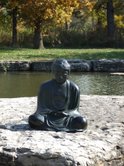
The sixteenth century mystic John of the Cross said “Silence is God’s first language.”  However, he did not have the advantage we do in the 21st century to know what every kid learns in their physics class that the universe is really noisy.  Just the term “Big Bang” connotes the potential for that reality, even in it’s apparent quite as we look out into space.  We might even say that it depends on what you mean by quiet.  Of course we know what St. John was really saying.  Silence is the normal context in which a contemplative practice takes place.  Not the physical, but the mental state of quite.  There is the outer silence that can surround us at times.  But it is the inner silence that is the challenge.  The quieting of the busy-busy mind we work to achieve in mindful meditation or zazen.  In zazen, we practice to not follow our thoughts.  But the contemplative state moves beyond this.  We sit to listen to the quite.  And that quite is heavy by nature.  We become quiet itself.  As Mother Theresa once said, “If you don’t understand that, I can’t explain it to you.”   It is at the intersection of mindful mediation and this inner quite that a contemplative practice begins.   Our meditation practice prepares us for our contemplative one.  They are not the same.  Zazen is study of the self in order to know the self.  With that accomplishment we become ready to experience the Universe beyond just it’s material expression.  Contemplative thought is a practice that brings about this third aspect of zazen, while mindful meditation works to achieve the first two.  Insight beyond the spoken language is the mind state of the contemplative.  We focus on a thought so we can manifest a contemplative-state of mind no longer requiring the thinking process.   We are propelled into inner quite.  It is an awareness of “something” beyond language to express, but our human capability to experience this wonder does not require a language to understand.

Most of us encounter effective quite moments when we attend retreats.  The reason for this is that in a retreat we get a chance to step back from our busy lives.  It is a time to “get into” quiet.  We may even “get a way for the day” and go out into the woods for some quiet-time.  In these moments we get a chance to draw inward and allow our mind to wander.  Then something happens and we experience a quiet state where are body-mind for a few minutes is at rest.  Sometimes we can create this moment from reading a special inspirational piece, especially if we are in our “scared” place, a place we find peaceful.  Your mind free-associates away from normal dispositions and personal preferences that provides the key to renewal and transformation.  Silence is the backdrop where this awakening takes place.
Continue reading

Leave a comment

Filed under David Xi-Ken Astor

Buddhist Lessons From A Christian Monk

By: David Xi-Ken Astor 

Some have said that the Christian Trappist monk, Thomas Merton,  is the man with rich wisdom and an everyday mind that was seeking a broad and pluralistic dimension to spirituality who caused the Dalai Lama to come to admire Christianity and it’s history of contemplative thought.  As a Christian Cistercian monk, Catholic priest, a world renowned spiritual guide and teacher of the contemplative life, Thomas Merton (Fr. Lewis) was not your ordinary religious cleric.  In fact, he was agnostic in worldview and philosophically opposed to organized religion of any tradition until later in his twenties when he became spiritually aware.  He was a writer, artist, intellectual, political activist at one time,  and a man of the world.  He was well educated with an over-active curiosity.  He even fathered a child out of wedlock while a student at Cambridge in England before moving to New York and attending Columbia University.  But something was missing in his life; and he was on a path to awakening, even if he was unaware of the potential at the time.  And when it came, it was for him, like being hit by lightening.  It was as immediate as was Alice’s experience with the rabbit hole.  He became one of the most important spiritual writers of the last half of the twentieth century.  And his writing impelled by his monastic life’s interests in the world’s spiritual traditions are recognized as a seminal and continuing catalyst for inter-spiritual dialogue in this twenty-first century.   Thomas Merton was a true ascetic and contemplative that constantly challenged his understanding of a spiritual life as his ego driven self kept getting in the way of finding the true self within.   He died young in Thailand while attending a world conference of monastic leaders in 1968.

Thomas Merton was his own bridge that fill the gap between religious and secular perspectives.  Some believe that he means almost more today to many than he actually did in his lifetime.  And I agree.  He is becoming an iconic figure who models inter-spiritual dialogue for those who are seeking a common ground of respect for the varied ways in which human beings realize the nature of our world.   As you hear me often say, there are many paths up the mountain.  And Merton recognized this early on in his contemplative practice.  He honored a pluralistic and pragmatic worldview when it came to leading a spiritual life.  Perhaps this was made more possible based on how he lived before stepping on a spiritual path.  Consider that he entered the riggers of a Trappist monastic life only six months after he received baptism as an adult.    His introduction to Buddhism set him on the path to find language to express inclusivity and respect among the various monastic traditions, in order to transmit meaningful change to a contemporary audience.  So I wish to explore the lessons that can be found in the way Merton practiced the spiritual dimension of what he came to be awakened to that shaped, and reshaped, his worldview.  And see if you can also find that when we step on a spiritual path, and when we learn to remove the filters that often distort our perspective, we awaken to the common elements we all share as humans seeking the spirit and wonder of this life’s journey.  Discover, like Thomas Merton did, that it does not always come from our own tradition.

Fifty years ago as a young man the Dalai Lima left his homeland and began a new life in India as a refugee.  In general his departure from Tibet and the circumstances that led to it are causes for much regret as he speaks about it.  However, these experiences have also inadvertently provided him personally with many reasons to be grateful too.  He mentions that among these are the many opportunities he has had to become better acquainted with the world’s major religious traditions.  He talks about how he has been welcomed at places of worship throughout the world, and has visited and shared practice at many places of pilgrimage.  But while having this pluralistic experience was important, he talks about the more important experience he has had in meeting spiritual teachers and making friends with them.  The Dalai Lima has written about the lessons he has taken away from these experiences that all the world’s spiritual traditions have similar potential to help us become better human beings.  For centuries, millions of people have found peace of mind in their own religious tradition.  But today we find followers of many faiths sacrificing their own welfare to help others, and to find happiness and human flourishing that is an important goal of all spiritual practices.

Continue reading

Leave a comment

Filed under David Xi-Ken Astor