Building A Spiritual Practice

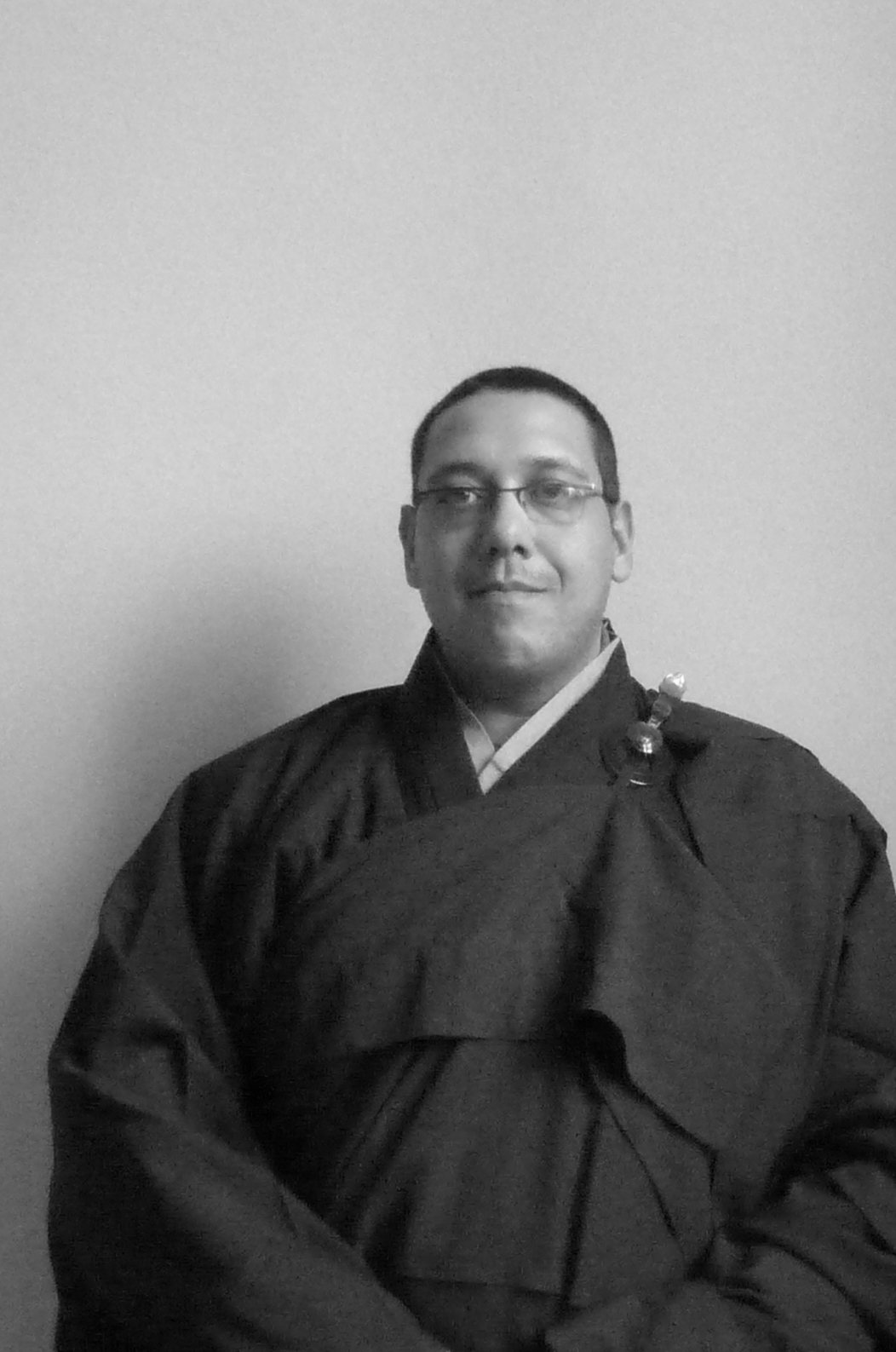
By: David Xi-Ken Astor, Sensei

I have been speaking recently about the importance of living a life by vows, either as lay Buddhists or especially for those of us that have taken monasticism as a life’s vocation.  Our monastic vows is a way of intentionally committing us to a social life of rigorous action honoring the Bodhisattva ideal above other competing personal responsibilities.   We are beginning to see in the West, however, a new secular teaching community arise that reflects, perhaps, a more realistic attitude to an ordained life within our communities beyond the walls of a monastery/temple.  In addition we are seeing monks that have decided to live outside of these “walls-of-practice”, but still adapt the monastic precepts as a guiding force for daily living.  No matter how we see our Buddhist practice developing, however, building the spiritual dimension to how we see the world around us is critical for having a well balanced life and worldview.  For after all, seeking the wonder of our Universe and spiritual wisdom to understand our role in it, is what it means for us to be human.  A spiritual life is both one of interior riches, and exterior displays of wisdom.  We must learn to balance these two aspects of practice in order to have a mature spiritual life.

I am reminded of the story of an elementary school teacher that gave her students a drawing assignment.  As she went around the room looking over the students work and giving encouragement and help, she was absorbed in the joy of the assignment as well.  As she approached Stephen totally entranced and furiously working on his picture, she was confused at what she saw on the paper.  When she ask him what he was drawing, he replied, “I’m drawing a picture of God.”  But she reminded him that no one knows what God looks like.  “They will in a minute!” exclaimed Stephen, as he returned to his work.  What Stephen is teaching us is a can-do, I’m on top of this, I know what I am doing spirit of the intrepid spiritual seeker.  He was lost “within himself”.  He is reflecting the “Buddha with-in”, or the natural nature of what is possible when committed to an ideal.   Then I suppose we grow up and loose the clear mind of the child.  Building a spiritual practice is like stepping back on the path we use to have before cultural influences cloud our minds.

Continue reading

Leave a comment

Filed under David Xi-Ken Astor

The Social-Self: Ethics Without A Creed

By: David Xi-Ken Astor, Sensei

When we speak about the Buddhist principle of non-self (anatman) we attempt to envision the notion of a self as expressing Universal realities without making the distinction that we are independent of all other Universal expressions.  Never an easy exercise.  One example of this would be that our human expression is only different from other animals simply by the complexity of our behavior — not just behavior, but our ability to reason.  Our ability to learn, gain knowledge that promotes wisdom, and thus act with reasoned intent, is what advanced human specie development.   In general, most individuals work to understand knowing something by penetrating what lies behind the appearance of things.  This approach is good enough most of the time perhaps, but considering how our mutual causal Universe expresses itself, we need to work hard to find the change that is presented in each moment’s situation in order to awaken to truthful-realities that consistently challenge the view we have of the world around us as having some kind of permanence.  Our quest for “truth” can never be fully realized when we ignore that change is always a factor in everything we encounter, so “truths” are only momentary, and a state of permanence is only an illusionary concept.

This brings to my mind several questions.  Is our knowledge of things sufficient to understand how they really are?  Is the language we use to describe how we are interconnected to things capable of fulfilling our needs as realistic as how they actually can?  Is our Buddhist practice, as manifest in our intentional actions, able to help us realize a better future for ourselves and others?   Is there such a thing as unconditional obligations in a Buddhist practice?   When considering ethics pragmatically, I have great doubt about the suggestion that anything is unconditional as the driving force of self-interest is a natural aspect of the human condition.  When we introduce the element of social relationships weighted against the distinction between routine and non-routine civil behavior as judged by cultural norms, we encounter possible inhibitors when we act from a feeling of what is natural to “us”,  but interpreted as unrealistic to others, even when we are both using the same set of ethical expectations.  These inhibitors come into play when our personal needs begin to clash with those of others.

Continue reading

2 Comments

Filed under Uncategorized

Spiritual Life Is A Life

By: David Xi-Ken Astor Sensei

The spiritual life is first and foremost a life in that it is apart of the sum of the phenomena we call “me”.  It is not something we “take out” and wear during periods of contemplation, meditation, or feeling like a Buddhist when we are in the mood.  Either we have it or not.  It is that simple.  A spiritual life is not something we can study.  It is however, like all other dimensions that makes us up, when it is not nourished it will die.  It can be like other interests we develop, spend time with, then move on to other things.  What makes finding a spiritual interest different is that it appears to be a natural progression when we turn our attention to the bigger picture of what life may be about.  Like seeking the wonder of our world, seeking the spirit seems to be connected to our human condition, not something handed to us “by the angels.”    We live as spiritual individuals when we live seeking answers to the big questions.  It is something man has been doing since he walked out of his cave and looked up at the night sky.  The difference between him and us, is that we now have a language to express our spiritual natures, but the experience is the same.

To keep our spiritually alive we must constantly work at it.  This is the reason we engage meditation and contemplative practices.  I am reminded of the experiences I have had on my sailboat at sea in the fog, peering into the gloom listening for sounds and hoping I stay on course in order to avoid being lost and reach the harbor.  The spiritual life is all about keeping awake.  We must not lose our sensitivity to what inspires us to sit in contemplation keeping alert for “signs” we can use to stay on course.  We must always be able to respond to the slightest warnings in order to avoid running our life on the rocks that can sink a spiritual life as well.

Meditation is one way in which the spiritual man keeps awake.  The reality of a contemplative life , however, is that it puts us at risk of becoming distracted and falling asleep.  Meditation is a strict discipline, and not so easy to do well, at least in the beginning.   It requires perseverance and hard work to avoid falling into the trap of compromise.  When our zazen and contemplative practice is compromised, it is a failure.  Even when we keep at it without much focus.   A contemplative practice is a body-mind practice, that is the orientation of our whole body, mind, and spirit.  When you enter into such a meditation practice it is not without a kind of inner upheaval.  By upheaval I don’t mean a kind of ciaos, but a braking away of a normal routine of thought.  We move away from ordinary mind into an extra-ordinary inner space.  We move away from all those distractions that preoccupy us in our work-a-day world.  We move beyond all that.  It is not something that is easy moving from an active mind to a passive one so we can experience the quiet necessary to transcend the ordinary.  The bridge is not easy to find either.  It may take years to find the bridge.  But once found, we know the way again.

Neither imagination or raw feelings are required for the transcending nature of the contemplative state of mind.  It is hard to put into human language, but there is a very real and recognizable sense when we tune into our inner space.  Our inner eye opens to the center of our spiritual natures.  Meditation and contemplation is the opening of this eye.

Leave a comment

Filed under Uncategorized

A Spiritual Life Is Not A Mental Life

By: David Xi-Ken Astor, Sensei

A spiritual life is not a mental life.  It is not thought alone that creates a contemplative state of mind.  It is not a life of sensation or felling of ecstasy.  Contemplation is not about stepping on the mystical carpet and flying away.

The contemplative aspects of a spiritual life, however, does not exclude thought and a deeper sense of awareness either.   But it is not just a life where the body-mind and imagination are excluded.  If that were the case, very few individuals would be able to have a successful contemplative practice without retreating into a cave for a decade or two.  Considering man’s social natures, that would not be a life enriched by an engaged social practice, but one totally turned inward toward the self excluding others.  Even though the intent of such a life might be honorable.  It would not be one most would associate with Mahayana Buddhism.    If we are to be truly alive, we must be committed to our practice body, mind, heart, and spirit, directing our compassion towards helping others.  For a monk, that is the heart of our Bodhisattva vows.

It is unproductive to try to achieve a contemplative state of mind merely by stringing thoughts together and then “thinking” about them.  While thinking is the first step in our contemplative session, we must use those thoughts as a springboard into our inner world that reflects the state of our practice beyond words and thoughts.  The quality of such a practice depends on the depth we venture into as we activate our inner-vision.  A purely mental practice may destroy any chance we have to go beyond the ordinary.  In that case we substitute thought and ideas for the real thing; for real awakened moments.  Any activity associated with what makes us human is not purely mental as we are not just a disembodied mind.  This is why validating our experiences is so important to our contemplative practice because it keeps us balanced.

What we achieve from a contemplative practice must also be brought back into our everyday lives in order to move our knowledge to wisdom that gets us ready for more awakened moments.  As we make it apart of ourselves, we enter into the reality that is signified by our concepts.  This is the cycle-of-life of a contemplative.

Thomas Merton in his work, Thoughts In Solitude, said, “Living is the constant adjustment of thoughts to life and life to thought in such a way that we are always growing, always experiencing new things in the old and old things in the new.  Thus life is always new.”    It is yet another illusion when we think that our contemplative mind state is separate from how we live our lives as though it is separate and two different concrete realities.  When we sit in contemplation we are not sitting in a dream state.  We must keep an alert mind not distracted by our personal filters that dilutes how we see the world, AND the Universe around us.  This is why zazen is so important.  In mindful meditation we are preparing the mind for the contemplative.  A quiet mind, is a ripe mind.  That is the platform upon which our contemplative practice stands.

Leave a comment

Filed under Uncategorized

Buddha Is Not Dharma

By: David Xi-Ken Astor Sensei

“We take refuge in the Buddha, the Dharma, the Sangha”.   If we follow Buddhist thought, and not accept a duel state of being, we may come to realize that while we make distinctions of the Three Jewels in practice, in reality they are not separate phenomena.  They are interdependent and connected as one reality, and are components of the principle of Inter-dependent Origination.  So, we come to ask the question, “how can ultimate reality be embodied in the form of a person (Buddha)?”   I would argue that if we strictly apply Buddhist logic, it isn’t.  It is a kind of paradox, and what is “ultimate reality” anyway?

We use the term “Buddha nature” rather freely sometimes without a clear notion of what we are talking about.  Yes, as human beings (and the historic Buddha was that) we are both Universal and unique expressions of the Universe at the same time.  Buddha nature is an expression that points to our inclusion in the Dharma; we manifest an image or reflection or intimation of that which can not be separate from all the other expression the Universe is.  Life as we know it can be considered as a large fabric woven of all the various expressions that in totality makes up what we know as reality.  Remember that science tells us that we have only identified about 8% of what makes up the Universe.  We have a long way to go yet in our exploration.  Dharma goes beyond this limited notion of reality to encompass both what we can know, and that which is unknown.

Continue reading

4 Comments

Filed under David Xi-Ken Astor

Considerations on the Monastic Vocation

By: David Xi-Ken Astor Sensei

“To be a person implies responsibility and freedom, and both these imply a certain interior solitude, a sense of personal integrity, a sense of one’s own reality and of one’s ability to give himself to society…”

Thomas Merton from Thoughts In Solitude

Living a traditional monastic life could be viewed as being very scandalous in that a monk, Buddhist or Christian for that matter, seems to have no specific task that could be considered a job in the secular sense of the word.  That can be a mistake if you think monks are free from work tasks in order to spend all their time in meditation and scholastic activities.  In reality though, the life in a monastic community has many tasks and organized routines so their world is very much similar to the social life like everyone else’s.  This is especially true when the monastic community is living outside the walls of the monastery.  This kind of social life can become complicated and overly active in a way.  Living as a monk does not shield you from all the life challenges of an ordinary life.  In reality it is filled with all the ordinary life tasks plus enhanced practice ones too.  A growing number of monks now work outside their houses in order to share in the support of their community.  The monk is not defined by his tasks, job or secondary profession, but by his commitment to his practice as shared with his dharma brothers under the guidance of his sensei.  In a certain sense the monk is supposed to live an unstructured life because his mission is to be ready to engaged the dharma in whatever form it is presented in the moment, with little family or social distractions.  This means that monasticism aims at the cultivation of a certain quality of life, a deeper level of awareness, an awakened consciousness which is not usually possible in an active secular world these days.  In this 21st century we have so many distractions to keep us from our practice.

I do not mean to imply that the secular lifestyle is somehow totally about self centered priorities, or that there can be no real understanding of the importance of developing an interior awareness.  But it does mean that more immersion and absorption in worldly business will take away from a contemplative mind state that is of utmost importance in gaining readiness for experiencing awakened moments.  There is much to be said about a sustained practice over one that experiences fits and starts.  Monks are not weekend warriors, but seek to be free from what William Faulkner called “The same frantic steeplechase toward nothing” which can be the essence of a Buddhist practice when engaged for a few hours a month.

As a monastic community lives together, either in groups or alone but connected, they do so with a sense that they are not separate from the lay community they live side by side with.  We should avoid any notion of “inside or outside.”  The concept of “separation from the world” that can arise in a monastic community is yet another illusion.  Even for those monks within the walls of a monastery/temple.  We must never forget we are social-selves and agents for change.  We do not take vows to become a different species of being.

Continue reading

Leave a comment

Filed under Uncategorized

Creating A Sacred Space & Buddhist Altar

By: David Xi-Ken Astor, Sensei

This guide is meant to assist in creating a home sacred space with an altar for your Buddhist practice.  These suggestions have been used by both OEB in our Chapter Houses as well by our lay organization, EDIG, for home use.  It is intended for the Ch’an/Zen practitioner, as the various Buddhist schools have different practice intentions that are reflected in how the various elements of a space and altar are utilized.   As contemporary Zen monks that work to find pragmatic lessons in all we do in life, we feel that how we approach our intentional ritual practice should be no exception.   It is not what we do, but how our body-mind is during practice that matters.  The suggestions here have been adopted by us that follows the tradition of David Sensei’s monastic roots.

An alter is one element of creating a sacred space where we retreat to quite the mind and sit in awareness.  The environment associated with this special space is what matters, not what is in it.  However, having meditation cushions, items that act to remind us of the importance of what we have dedicated ourselves to practice, and a consistent location is of importance.  How we go about fulfilling these requirements will be different for each of us, depending on the various demands our private lives require.  There will be as many options and materials to use as there are creative ideas.  There are very few rules to follow.

The sacred space you create can be used for both zazen (mindful meditation) or contemplation.  But it is highly recommended that a separate element be added to your space for contemplative practice that is different from where you sit for meditation.  This is done so the bodymind is clear as to what practice you are about to engage.  Meditation cushions are generally used for meditation, and a chair is used for contemplation.  Always do meditation first before contemplation so your mind in meditation is quiet and not in the thinking-mode as a result of your contemplation period.  Most individual finds it helpful to do the two practices at separate times of day/night.

So, enjoy the project and send us pictures of what you have accomplished.  While one of our monks will not be able to visit your space in order to bless it, if you ask us to, we will do so with intentional mindfulness during one of our daily monastic services.

The Space:

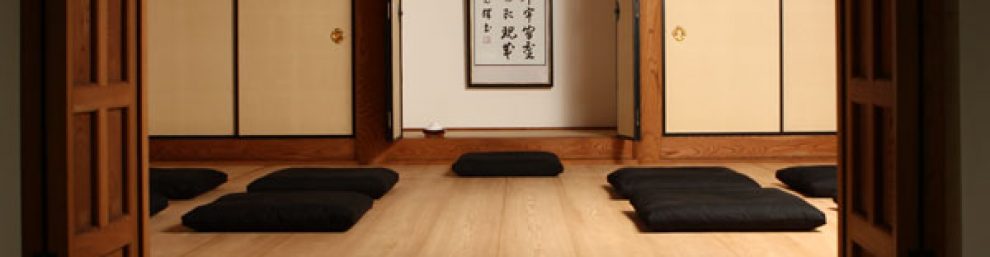
Choose a location that is away from the more active areas of your home.  This is often a bedroom.  However, if you use a bedroom that is shared with a loved one, make sure you talk this over with them in order to obtain a consensus.  It is quite OK if the space is shared with others.  The area should be able to be shut off from the other spaces in the home during meditation/practice periods, if possible.  A space with limited or low light, and that is well ventilated, is preferable.   The idea here is to limit distractions, and create a space that is comfortable and inviting.

As mentioned, it is not necessary that the space be permanently set-up.  You might keep your supplies in a container and the cushions stored in a closet or under a bed, for example.  You can also acquire a wall altar that has doors that shut when not in use.  This is an excellent alternative for small spaces.  Many altars have been set-up on a bookshelf, and the meditation cushions brought out during practice time.   So be creative.  But the one basic requirement is that the space be consistent.   As we train the mind to be quite, having a familiar space helps.

The Altar:

A home altar is difficult to define.  It acts as a focal point of our practice space.  It is an anchor, and in many ways, represents our intentions.  As such, it can be very personal, and what we bring to it gives special meaning as we practice with it.  There are very few necessary elements that may be considered necessary; everything else are personal touches.

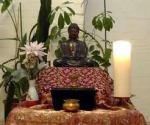
We recommend that your altar consist minimally of three tea candles to represent the Three Jewels, an incense burner, and a representation of an Universal expression.  The Universal expression is where your creative imagination comes into play.   Most often it is a statue of Buddha.  But that element is not necessary.   Other iconographic images can replace the image of Buddha.  They can be an eight-spoke Dharma Wheel, an image of the mudra hand, a specific image of a column, a thrown, flowers – especially the lotus, and something like a fan with the Heart Sutra printed on it.   Perhaps a nice scroll or print on the wall behind your altar is something that you already have that you enjoy.  Some altars have a ‘minimalist’ look with the candles, an incense bowl and a few flowers.   Unlike the Tibetan or Pure Land Buddhist schools, it is not necessary to face your altar in a specific direction or level of the house.  A basement space is fine, and often preferred.  Don’t think your altar must be like what you see in temples and practice centers.  A home altar should reflect your own needs for achieving a body-mind state of peace and contentment.

The layout of the altar can vary, but the one we use that is more common to Ch’an Buddhism and adopted by the Order of Engaged Buddhists as well as our lay organization, EDIG, is: the Universal expression such as a Buddha should be placed in the middle.  The three tea candles are placed one to the left and right sides, and one in the center of this image.  The incense burner is placed behind the central image.  If you don’t have space behind the Buddha image, place it in front but behind the central tea light.  Other items can be placed on the altar but in a way that does not disrupt this basic layout.  For example, I keep a picture of my three teachers to the far left, with a red votive candle in front of my late teachers picture.

Place your altar along a wall or in the center of a room.  Put your meditation cushions in front of it about five feet back giving you room to light the candles and perform the incense offering ritual.  If you have a cheng bell, it should be placed to the right of the cushion, and a fish-drum to the left.  This is not necessary at all.  But as your practice matures, you will want to add these to your practice space in order to do bell meditation.

Have fun putting your altar together, but be thoughtful.  Maybe your altar is going to be a “work in progress” until you find the right elements that express your personal practice intentions.  Use the pictures below for some ideas.
alter12alters1

alter10

alter3

alter11

If you are interested in obtaining a copy of the Order’s Daily Monastic Service, please send us a request with your name and address and we will make sure you receive one.  The bound service book is $8.00. 
 

1 Comment

Filed under Uncategorized

Is Being a Contemplative Buddhist, Being a Solitary Buddhist?

by: David Xi-Ken Astor, Sensei

We can meditate alone or with others.  When attending a Buddhist center we do so with others, and with others we listen to the Sensei delivering a dharma talk.  Even within a monastic community the monks generally sit along with others.  In fact sitting with others is an entirely different experience than when we sit by ourselves, it is often more intense.  A contemplative practice, however, is better done alone in solitude.   A contemplative practice is not teaching us to be solitary, that would be absurd.  Even for those that have chosen to live a monastic community life do so with others.  Those who wish to be solitary are, as a general rule, expressing their solitary character that is not how the Buddha expressed our human natures to be, especially for us that value engaging the dharma.  We are, after all, social selves.  The Four Noble Truths and the Eightfold Path is about self and others.  Steven Batchelor expressed it as “alone with others.”   Interconnectiveness and interdependence are primary principles of Buddhist thought.

There are also many examples of individuals that can not stand to be alone.  It drives them crazy.  Our culture and social values provides ample opportunities to enable us to avoid our own company and be with others almost twenty four hours a day.   Even when we are in a room alone, we can turn on and tune in to so many modern devices that bring others into our room even if they are electronic-people.   Just noise can eliminate being alone, even if it is just in our minds.   Being truly alone is hard work in our contemporary 21st century world.   Men can’t live without society, that would be almost impossible today.  Those who claim they would like to live in solitude and are able to, are often those who depend most on others, even if they are not aware of this simple fact.  Their pretense of solitude is only a clear admission of their dependence, another type of illusion.  Even another example of suffering.

Our communities enable us to care more easily for ourselves which gives us the capability to care for others.  This is an essential element of what makes us human as advanced sentient beings.  Yet, there is great value in taking the time to be alone, both physically and in a contemplative mind-state, in order to create the solitary-environment that can promote experiencing awakened moments.   Another aspect when considering the notion of solitude is that of interior solitude.  We retreat into our private space so we can activate this inner observer that is apart of a contemplative solitary interior practice.
An authentic contemplative is not one who simply withdraws from the world.  The act of social withdrawal from others results in personal suffering and a sick kind of solitude without a useful and harmonious out come.  A contemplative monk is called not to reject the nature of his social-self but to transcend it using social interaction with others as a reminder that just living in the material world without “looking up” into silence is a life void of realizing a world that reflects back into our eyes the meaning of the wonder of its majesty.

An essential component of this interior solitude is that we practice rigorous self-honesty and not develop a self-centered sense of our importance by “doing” what we think is serious practice.  This is our ego talking.  We must remember that when we direct our mind toward universal suchness, we our at the same time encountering it as mystery.   By nature mystery is just that, a mystery, unknowing.  Another essential of this interior practice of solitude is the actualization in which we take responsibility for our own inner life.  We face its full mystery as is that of our own universal expression.  We take upon ourselves the barely comprehensible task of working our way through the unknowing aspect of our own mystery-ness and become aware of how we and the very Universe we work to comprehend is the reality beyond common knowing.  We accomplish this by losing all words and language to express it.  What is interesting is that there is nothing particularly special or spectacular about these glimpses of Dharma.  Don’t expect “the ultimate answers.”  The Universe will always remain a mystery.  But we can learn to sense a connection that resolves into great doubt that works to sustain our contemplative practice to go further.  These become moments when we confront the solitary aspects of our contemplative practice, and by so doing, find we are not alone after all.

Leave a comment

Filed under David Xi-Ken Astor

Ideas Aren’t The Real Thing

by: David Xi-Ken Astor

As we engage mindful meditation and insight practice in the beginning of our encounter with zazen we are taught that there are different ways of understanding the states of mind that can be realized during periods of meditation.  If our initial study of meditation is gained through books, we quickly read about terms like no-mind, quiet the mind, oneness, and realize your true nature.   Unfortunately, all these terms can add to our confusion about a contemplative practice because we come to think about them as things to be acquired or achieved.   We Westerns feel comfortable with this approach because we know how to go about getting something that we consider substantial, either as a material object or a tangible achievement.  No problem, because with a little bit of hard work we earn the right to grab the golden ring.   Then we have something to show for our efforts, an object, even if that object is a certificate.

Because of our mental confusion, we quickly trap ourselves by trying to make our experience match our ideas.  The notion of a quiet mind is a good example.  We think we know what “quiet the mind” means.   We assume there is a mind, that it can be made quiet, and that if we work hard we can do it.  Usually when we think of a quiet mind, we have some notion that we have stopped the thinking process and that this state of mind is sustained over time.  This would suggest that we have stopped being aware too, because thoughts come from awareness.  With this idea, individuals can spend years trying to get rid of thoughts so that their experience will match their idea of quiet mind.

For those of us that have dedicated ourselves to zazen for years (decades even), it is kind of sad to see others mired in a helpless quest for the experience they think they should be able to get, but can’t.  True, from the perspective of noisy mind there is a state of less noise for them.  But in experiencing a deep sense of quiet, there is no awareness between quiet or active mind.   Old Zen masters would say we come to realize mind as “Just like this.”  It exists only from the perspective of the knowing mind.  Enlightenment is as well, existing only as an idea held by the mind of separation.  Oneness exists only from the perspective of two-ness.  We must awaken to the lessons that point to no-mind found in understanding the difference between the dual and the non-dual.

It is essential that we have aspirations in our Buddhist practice.  But these are only pointers, like the North Star helping us to point the spiritual path we tread headed in the right direction.  Experience can’t always be expressed with words.  What is the experience of eating an orange for example?  How do you put in words the feeling when you look into a baby’s eyes.  What is loving kindness feel like?  If we think our conceptual understanding touches the real thing, we are like someone watching a video of someone ascending the Himalaya Mountains who thinks they understand mountain climbing.

Instead of trying to match your conceptual understanding with what you imagine as real, cultivate great doubt.  To do this, let go of ideas.  When we have no ideas, we position ourselves for the potential of realizing our unique Universal expression.  The Buddha nature that encompasses the spirit and wonder inherent in the face we see in our mirror.  Or is it the face behind the face reflected back to us like the reflection in a clear pond?

Leave a comment

Filed under David Xi-Ken Astor

Deeper Self, Encountering Silence

by: David Xi-Ken Astor

The sixteenth century mystic John of the Cross said “Silence is God’s first language.”  However, he did not have the advantage we do in the 21st century to know what every kid learns in their physics class that the universe is really noisy.  Just the term “Big Bang” connotes the potential for that reality, even in it’s apparent quite as we look out into space.  We might even say that it depends on what you mean by quiet.  Of course we know what St. John was really saying.  Silence is the normal context in which a contemplative practice takes place.  Not the physical, but the mental state of quite.  There is the outer silence that can surround us at times.  But it is the inner silence that is the challenge.  The quieting of the busy-busy mind we work to achieve in mindful meditation or zazen.  In zazen, we practice to not follow our thoughts.  But the contemplative state moves beyond this.  We sit to listen to the quite.  And that quite is heavy by nature.  We become quiet itself.  As Mother Theresa once said, “If you don’t understand that, I can’t explain it to you.”   It is at the intersection of mindful mediation and this inner quite that a contemplative practice begins.   Our meditation practice prepares us for our contemplative one.  They are not the same.  Zazen is study of the self in order to know the self.  With that accomplishment we become ready to experience the Universe beyond just it’s material expression.  Contemplative thought is a practice that brings about this third aspect of zazen, while mindful meditation works to achieve the first two.  Insight beyond the spoken language is the mind state of the contemplative.  We focus on a thought so we can manifest a contemplative-state of mind no longer requiring the thinking process.   We are propelled into inner quite.  It is an awareness of “something” beyond language to express, but our human capability to experience this wonder does not require a language to understand.

Most of us encounter effective quite moments when we attend retreats.  The reason for this is that in a retreat we get a chance to step back from our busy lives.  It is a time to “get into” quiet.  We may even “get a way for the day” and go out into the woods for some quiet-time.  In these moments we get a chance to draw inward and allow our mind to wander.  Then something happens and we experience a quiet state where are body-mind for a few minutes is at rest.  Sometimes we can create this moment from reading a special inspirational piece, especially if we are in our “scared” place, a place we find peaceful.  Your mind free-associates away from normal dispositions and personal preferences that provides the key to renewal and transformation.  Silence is the backdrop where this awakening takes place.

Continue reading

Leave a comment

Filed under David Xi-Ken Astor