Category Archives: Uncategorized

Awakening Revealed In Few Words

By: David Xi-Ken Astor, Sensei

A monk ask, “What is liberation?”
Shitou replied, “Who has bond you?”
Another monk asked, “What is the Pure Land?”
Shitou said, “Who has polluted you?”
Another monk asked, “What is nirvana?”
Shitou said, “Who has given you birth and death?”

The great Chinese Zen Master, Shitou Xiqian, who lived in the eighth century was a key figure in the development of Ch’an Buddhism. Three of the five traditional schools of Chinese Zen can trace their lineage through his disciples down to the present day, including my own. Shitou taught that “what meets the eye is the Way” A very pragmatic worldview, and one that hints at the influence the Tao had on Buddhist thought and practice in his day.

Master Shitou is said to have had a great awakening while studying the Zhao Lun (A classic text of commentaries on the sutras). In that work he encountered a passage that said, “The one who realized that the myriad things are one’s own self is no different from the sages.” This realization inspired Shitou to write a number of verses, each more refined and elegant than the last as he worked to broaden his state of enlightenment further. Finally he choose just fifteen Chinese characters to represent the awakened wisdom of a mind free of distortion. In English it takes twenty two words to translate:
Each sense and every field
Interact and do not interact;
When interacting, they also merge —
Otherwise, they remain in their own states.

It is not my intent here to provide a full commentary of this verse. But I will give a broad hint as to how to begin to understand this simple, but very deep wisdom gained over many years of contemplation. Consider “each sense” as meaning a gate, entrance or even an exit point. The phrase “every field” means all-encompassing objects or things outside of ourselves, especially the sense organ of mind. That sense, while we can not touch, see hear, smell, or taste it, it can be imagined. Abstract concepts can be objects of mind. While we can not perceive these things, we can awaken to their reality. The sense organs and their objects are the totality of our lives, and when we learn to coordinate their inputs plus the exquisite functions of mind we can grasp the meaning of “emptiness.”

With this in mind, work to understand each word in this verse as an individual piece in the awakening puzzle and with their separate meanings established, fit them together, and in so doing you will see their individual forms disappear, and an awakened view of all reality emerge.

3 Comments

Filed under Uncategorized

The Nature Of Dana: Generosity In Action

By: David Xi-Ken Astor, Sensei

The nature of dana, generosity or giving, relates directly to hearing and responding to one’s spiritual calling. In Master Dogen’s ‘Shobogenzo’, two chapters address dana in different ways. The first talk is entitled “Establishment of the Bodhi Mind” and was directed to the laity, and the second is called “Establishment of the Will to the Supreme” which Dogen addressed to the temple monks. These talks were given on the same day about six hours apart we are told, just after Dogen entered his new monastic home in the mountains.

The first instruction was given to the laity as a lesson on generosity of life as it is. He was imploring those who were donating money or labor to the temple, to continue to do so. An age old challenge that continues to haunt Buddhist teachers even today. A little time later, he offered a talk to the monastics in his newly established monastery, but this time focusing on impermanence, the absolutely fleeting nature of life. He beseeched the monastics to give their life away to others, to not get lost in zazen and the solitary practice of realizing themselves before taking care of all beings, including those he had addressed six hours earlier. These two teachings, different in perspective but focused on the same subject, takes dana as the act of contributing to the Sangha’s upkeep and highlights its place in a compassionate practice. The human emotion of compassion is developed when you give selflessly. Likewise, when one receives they are given an opportunity for experiencing feelings of compassion.

Dogen was a master strategist as well as a brilliant dharma teacher as his written works in our possession today reflects. His wonderful teaching reveals dana within a beautiful, circular path, flowing in both directions among the laity and the monastics. Utterly and forever different, each giving to the other. The recognition of the inter-being of self and other. The social-self in action. Through these two we create a wonderful interplay of dana, of exchange, of one hand supporting the other and the other supporting the first to the point that it is not clear which is giving and which is receiving. That is when we enter into the heart of ‘dana paramita,’ the perfection of selfless giving. The term ‘dana’ when used alone is referencing our actions toward upkeep of something we highly value. The term ‘dana paramita’ encompasses all acts of generosity, including those of supporting directly the transmission of the dharma. Continue reading

3 Comments

Filed under Uncategorized

Intimacy With Unity Of All Things

By: David Xi-Ken Astor, Sensei

 In a wonderful Tibetan Buddhist story, a man tells his friend about an extraordinary spiritual teacher he has met. Although this friend is curious about this teacher, he is also somewhat skeptical, so he decides to seek out this holy man and put him to the test. After asking around, he discovers the master is living and teaching nearby, so the young man goes to see him and manages to obtain an audience with him. He defiantly walks before the teacher, and before he can catch himself, blurts out a challenge: “Show me God! Prove to me that he exists!”

The saintly master calmly extends his hand and, in a soothing, inviting tone, says, “Come with me.” The young person takes the teacher’s hand, in the Asian sign of friendship, and off they go to the neighborhood lake. As they reach the place, the teacher leads the man into the water and tells him to dive in. Then the master does something even stranger. He holds the mans head under the water. As the minutes pass, the man tries three times to come up, but the Lama holds his head firmly submerged. Finally, on his fourth attempt, the teacher lets him out of the water. The poor soul bursts out of the water, gasping for air. “What are you trying to do, kill me?” he yells at the saint. The holy man looks at him with infinite compassion and lovingly, patiently responds: “Forgive me if I caused you undue anxiety, but when your desire for God is as desperate as your desire for air, for your very breath, then you will find the source for Creation!”

This powerful story dramatically illustrates the importance of commitment in the spiritual life. No genuine progress is possible without it. Such a commitment expresses itself in the discipline of regular, daily spiritual practice that paves the way for breakthroughs, for the miracles of grace to happen.

Spiritual practice is the core of our transformation, and it requires what can be called the contemplative attitude, a disposition to life of mystical depth. Spiritual practice often means meditation and other forms of inner exploration. It can also mean prayer. Silence and solitude – the seeking of illumination and wisdom – are further parts of the contemplative experience, a process of our ultimate evolution, our unfolding to higher states of awareness. To understand how this process can unfold in our lives, we need to explore its elements.

This is what I hope we are doing here at OEB. Our personal experiences provides us an opportunity to gain knowledge. Application of knowledge, when done in the spirit of right intent, is wisdom. We live in a mutual causal world. Everything happens as an effect of another action. Either human or not. It started at the moment our Universe was created. We are here as a result of that original event. Everything we think or do is a continuation of that action. Even our deaths contribute to this Universal expression. It is up to us to discover the contemplative dimension of life and experience what it means to be human on a mission to understand the unity of all things.

1 Comment

Filed under Uncategorized

Pursuit Of “The Good” Is Another Illusion

By: David Xi-Ken Astor, Sensei

Goodness is a noble quest, but the pursuit of good is another form of living an illusory life. We must be wise in our understanding of the ethical reality in the meaning of the Three Pure Precepts and how we connect with others. If an individual wishes for others what is good for themselves without really knowing what that good is, then the potential for doing harm is real. We know in principle that happiness can not be found in hedonism or utilitarianism (the profit motive). A life pursuing pleasure, ambitious self-centered interests alone, or riches results in a kind of intolerable servitude where what we seek will be always out of our grasp. This type of life-path is always about trying to find ways of surviving in the future and may be incapable of living in the moment. The Buddha would say that a life only motivated by profit and pleasure is unworthy of one walking the Path.

Yet we need to be careful in thinking that a heroic, virtuous, and self-sacrificing life is an ideal one. Considering a life based on “being good” can be fraught with ambiguities surrounding the notion of what is good. What one considers good can be making another value statement. History teaches us that the goodness of the good and the nobility of the great may contain the hidden seeds of ruin. What is interesting about a Buddhist practice of perfecting doing good is that it often reflects that same ambiguities as the hedonist or even the utilitarian. Why? Because working to achieve doing good as an object is engaging in a self-conscious and intentional pursuit to do good in a belief that one’s actions are right and therefore will achieve happiness. This way of social engagement is putting happiness and the notion of what is good as something to be attained, and thus places them outside selfless action and into the world of object, as though good was a commodity. This results in a life-dilemma between one not yet in possession of what they seek as good, and the future in which one things they will have what is desired in order to counter unsatisfactoriness. This dilemma is about how an individual interprets what is right or wrong, as opposed to the notion of right and wrong held by others.

We can find resolution of this dilemma in our practice by not debating with ourselves on what is happiness or unhappiness by trying to find what “should be done”. Doing good should never be debated if we also have an adequate understanding of the situation and not try to over-think the karmic consequences. We can never know for sure how any good action will work out in our mutual-causal world. The more we seek doing good from the perspective of desired consequences, we enter into the weeds of over analyzing the nature of the importance of just trying not to do harm.

An awakened Buddhist practice recognizes that our body-mind is ready to do good as an expression from our Buddha natures. Instead of self conscious cultivation of what is good, we grow quietly in the humility of a simple, ordinary life, and this way is trusting that our actions come from a cultivated body-mind rather than seeing it as the fruit of our efforts. This is a practice not intent upon results and is not concerned with consciously laid plans or deliberately organized endeavors. It is a life awakened to how each moment is and how we are reflected in it. It is about learning to find the harmony in each moment, and between the elements we meet in those moments. If one is in harmony in the moment, happiness and goodness will make itself clear when the time comes to act, for then one will act not according to the human and self-conscious mode of deliberation, but according to the awakened social-self that is the source of goodness. The other way of acting is conscious striving, even though it may claim to be a way of virtue, is fundamentally a way of self aggrandizement and pride, and will be in conflict with the path away from suffering. This is not an easy lesson to comprehend, as it takes time to realize how to act from a deeper place cultivated from our silence. Thus we sit in silence to cultivate serenity from which compassionate action arises.

Leave a comment

Filed under Uncategorized

Duty: The Selfless Practice

By: David Xi-Ken Astor, Sensei

I can not help but wonder about the simple word “duty” and why we do not hear it used so often in our contemporary speech. It almost seems like an eighteen century word used in a more nobler time to refer to action of the highest perfection of human nature. Duty being a responsibility to a higher cause, or to the state perhaps. But I am looking at this word with new light as I also consider the importance of the vows we profess when we step onto the Buddhist path seriously. It almost seems to me that we shy away from considering our practice as a duty rather then a wish fulfilling need. Duty may tug away from our notion of freedom even. If we are working to achieve a state of selfless practice, are we not also, through the power of vows, acknowledging the existence of duty as a force of our obligation to serve others?

What creates the realization of the sense for duty in our practice that transforms itself away from mere obligation? Is our understanding of how to act in our practice not from duty but from expedience reflecting how we think we should act as Buddhists? Is our practice self-serving in some aspects? Those whom their practice binds through conscience rather than by traditional expectations are doing so out of moral authority, and is for them a sense of duty from which the dictates of conscience flows. The power of this dutiful commitment arises out of having made a vow driven by a personal obligation to discharge our notion of social justice even when it is not commanded by higher authority or religious expectation. The “just person” living their vows does what he should do because it is just, and because justice is essential to the very being of a Buddhist practice. When we come to understand deeply how duty arises from living our vows we come to awaken to the immediate source of the obligation to act in a certain way. These intentional virtuous actions are the highest state of excellence of human nature. No matter what spiritual path you are on. Virtue, a component of duty, alone provides the motivation that allows us to extend an altruistic hand that embraces everyone with equanimity. It is the motivation that recognizes the “social-self”. Without this awareness, we do not have a Buddhist practice.

Plato considered virtue as comprising justice, temperance, courage, and wisdom. But without justice, he considered the other three as having little merit. The foundation for that thought was because justice concerns the relation of man to his neighbor. It is the recognition of the value of interconnectiveness and the dependence we have for the importance of other. You see, when we consider temperance and courage we are isolating these human traits for the well being of the individual. That is why showing justice entails duty which is the obligations to act in a certain way for the welfare of others. If the good of no other individual is involved, it seems to me that a person has no duty to be temperate or courageous, even when he possesses these virtues. This is the lesson associated with understanding how we can be “alone with others”, as Stephen Batchelor describes it. Our taking vows is for the benefit of all others, without whom there would be no reason to practice the bodhisatta ideal. I’m teaching from a Mahayana perspective here. Let’s not forget that I am speaking about duty not to an individual person or belief, but from the moral imperative encompassing ourselves AND others alike; the human condition. Acting from this perspective of duty, our actions consists in the submission of the will to reason and in overcoming contrary inclinations or desires, even our personal preferences.

Duty then challenges us to a life of inquire. If we fail to seek the truth of how the dharma is presented to us as we live our vows, we have no chance to awaken to the nature of our Universal human expression. So to live well is to do our duty through our practice and to set aside all contrary desires and obligations that act as inhibitors to a Buddhist life. We are not Buddhist when we are being other things unaware of our vows. Our Buddhist character must be present in each of the other roles in life we have undertaken: spouse, sibling, child, teacher, business partner, and any of the other roles we come to represent. That is our duty as we live our vows. We should not be conflicted or torn by competing loyalties or obligations which pull us in opposite directions. When our various roles command contrary action, duty is weighed by our conscience. When we come to value the encompassing and corrective lessons woven throughout the elements of the Eightfold Path, and understand the principles of moral and ethical justice reflected in the Four Noble Truths, we will no longer experience the ordeal of conscience from conflicting duties when our ego is at rest. We can always find an honorable path for our actions to follow when our sense of duty becomes second nature.

Leave a comment

Filed under Uncategorized

Change And The Power Of The Human Spirit

By: David Xi-Ken Astor, Sensei

The current events in the Middle East, and especially in the current conflict between Israel and the Palestinians, should be kept in mind as we reflect on the importance of cultural transformation in the 21st century, and the pressures associated with conflicts that have their basis in religious differences that can spillover in troubling ways for us removed from the realities of a particular region.

We now face a new challenge and opportunity: the end of isolation all around the planet as previously remote cultures and societies open up to one another. The world’s religions have been for centuries separate cultures, but now their boundaries are giving way as we find new relationships with other traditions and enter into conversation after a very long silence. Since the Second Vatican Council, along with extensive ecumenical and interfaith encounters in Europe, India, and America, the religions have been coming out of their self-imposed isolation, and through encounters with one another, have discovered common ground. This common ground is primarily a matter of those serious, practical issues we all face: injustice, abuse of human rights, economic exploitation and inequity, the pursuit of peace, spreading ecological responsibility, promoting educational and employment opportunities, and the desperate plight of refugees, women and children in certain areas of the world. This loss of isolation has also created deep resentments in many conservative practitioners who cling to the closed primacy of their beliefs. We are witness to this as we experience the violent expressions of Islamic fundamentalism, or narrow minded and culturally isolated pockets of Christian fundamental extremist interpretation of the Gospel’s message. Even in Buddhism we find some traditions isolating themselves from other Buddhists over the issues of how to interpret some of the basic principals of the Buddhist doctrine. But as the world’s spiritual traditions continue to learn from one another, the small segments responsible for so much turmoil will slowly fade in their influence, if we only continue our universal dialogue with each other.

Through interfaith organizations like the Parliament of the World’s Religions, the World Conference on Religion and Peace, the Temple of Understanding, the World Congress of Faiths, among others, the followers of various traditions are discovering bonds of community. Our own Engaged Dharma Insight Group is a member of the Interfaith Conference of Metropolitan Washington for example. This profound and growing sense of community is the basis of the new relationship between the leadership of these various traditions. There are exceptions of course.

This experience of community among the traditions leads to an openness to the spirituality present in each one of them and an eagerness to explore spiritual life and practice across traditions, a unique phenomenon of our time that we can call interspirituality. A term first used by the Catholic monk Wayne Teasdale more then a decade ago. Now, I will agree that this degree of openness is often limited to the leadership and not surprisingly the “more liberal” clergy. The laity, in many cases, are ahead of their own leadership, especially in the more orthodox traditions, including the more “orthodox” Buddhist teachers. Interspirituality is not a new form of spirituality, or an overarching syntheses of what exists, but a willingness and determination to taste the depth of what it means to be human and to seek the spirit and wonder of this world. Our knowledge of other religions and cultures is likewise increasing, opening the door to a universal understanding of religion, spirituality and world culture.

This is a scenario for the beginning of this new millennium, a movement to open doors and forging relationships leading us to a new universal civilized culture. In this new world culture we would be welcoming to all religions, achieving a genuine universal spaciousness that allows for diversity. A civilized social structure governed by considerations of kindness, mercy, compassion, selflessness, and nonviolence; a civilization in which political, economic, and military power have given way to the power of compassion as we see it portrayed so irresistibly in both the Gospel’s message, as well as in Buddhist teachings found throughout the Pali Cannon.

The different traditions would no longer see members of other faiths as outsiders. They would promote the study of these traditions, seek common ground and parallel insights, and encourage celebration of what we have that binds us, not what separates us.

Once the great traditions have a permanent structure in which to communicate their concerns, insights, and methods, they will collectively become a potent force to check the often irresponsible actions of governments. It requires acceptance of a universal responsibility we can all find in the practice of our individual traditions. It will also require the reform of some of our social systems, especially those of education, economic, moral, and the special needs of those less fortunate than ourselves.

Our Western civilization has been based on three great institutions, the family, educational structures, and the Church (I use the term with a universal meaning). It was the way our moral and ethical standards were transmitted between generations. And what does our experience till us today about these pillars of cultural stability? I see the system as broken. When I was growing up I went to church with my family, we had a morning prayer in home room class in all my grades in public school, the church was were I had most of my social interactions when I was young. My youth and scout groups were church based. I know we live in a causal universe, nothing remains the same for long. Change happens. I like change, my life is about change. And I many be reminiscing like someone my age might. But my point is that we need to consider how to get back to basics. How to restore the best intentions that can drive a pluralistic worldview between the different world cultures in order to meet the challenges of the 21st Century. How do we re-energize the national dialogue? For us to do so we will need to shed some of our old rhetoric and actions. We will need to become far more inclusive and less judgmental of other’s beliefs and traditions. Such a miraculous change is possible and maybe even inevitable.
Leave a comment

Filed under Uncategorized

Ask A Monk: Questions From the Cushion

By: David Xi-Ken Astor, Sensei

From time to time I like to share with our Sangha some of the questions we receive either at our centers from the meditation hall, those ask during a one-on-one session with us, or by correspondence, and our answers to them. Perhaps these are some of the question you have been wondering about and have not ask, or the question reminds you of a similar topic you need clarification on. So in preparation I have researched my achieves of notes and correspondence and have selected what I think is a broad spectrum of subjects that might be of interest to those of you with a developing knowledge of Buddhism, or someone just showing an interests. The questions are taken from those not ask in confidence. Skillful means is called for in these types of question as the questioner often has limited knowledge of Buddhist philosophy and practices, and an academic response is not called for. As you listen to the answers, test your own knowledge of the subject and how you might answer if given a chance. So, take out paper and pen and make some notes that you can use in the discussion period that will follow.
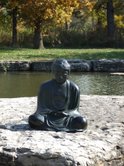
I’ll start by sharing with you questions I was ask by a University undergraduate student that contacted me asking for help on a research paper she was doing for a religions studies class.

1) What impact does the Eightfold Path have on your daily life? Does it come into play in your decision making?

A – The Eightfold Path is a practical guideline for leading an ethical and moral life with the goal of helping an individual move away from negative attachments and delusions. As a Buddhist monk in a socially engaged order the vows I undertook reflects all the underlying elements recognized in this path. They effect the way I view daily situations I encounter and influence the intent of my actions. I put great emphasis on the practical aspects of this path, and it is through practice that I can achieve dong good for myself and others. It most defiantly comes into play during decision making as I remain aware of how the path teaches wisdom, reflection on how my conduct must reflect ethical standards I have vowed to maintain, and also how following this path develops mental awareness. I view the Eightfold Path not to be considered as separate or sequence of single steps, instead they are highly interdependent principles that have to be seen in relationship with each other.

2) How big a part does meditation play in the Buddhist faith? Is it a daily activity, or reserved for special occasions?

A – First, let me say that it is easy when reading the available literature on Buddhism in this country, including textbooks, to have Buddhism referenced as a faith-based belief system. Siddhartha Gautama, the Buddha, was very clear that his teachings are to be based on what we are able to experience and verify in our own life. Considering Buddhism from a pragmatic perspective we consider it to be a practice-based philosophy with spiritual dimensions. It is up to the practitioner to realize their full potential.
Meditation, and specifically mindful meditation (Zazen), is a key component of the practice of Buddhism. The Buddha spoke often of the importance of training the mind to be aware, and meditation is the major aspect of this effort. I sit in meditation twice a day for forty minutes each as a part of my monastic service and practice-life. In all our centers we begin with a period of meditation generally lasting thirty or forty minutes before we move into other body-mind practices, like Qigong, before the Dharma talk. So, meditation is a major aspect of our Buddhist practice, and one the Buddha consider essential for developing an aware mind.

I think in America, and in the West in general, meditation is considered almost a necessary aspect of Buddhist practice, and as such, you will find in most of the Buddhist schools, some form of meditation. This is not necessarily the case in Asia, where meditation is generally practiced in the monasteries among the monks and nuns, but not among the laity. Meditation is encouraged to be a daily practice and not reserved for special occasions.

3) The rites of marriage and death are a significant part of most religions. How does Buddhism celebrate these or any other rites?

A – This is an excellent question. Very early in the Buddhist American experience, and especially as Zen Buddhism was introduced, the practice of rites was considered not necessary. In fact, Zen was considered to be without any structure almost. But now we know this was not the case. Rites, ceremonies, and ritual practices can be found in most all Buddhist schools worldwide. Among the rituals regularly performed in most Buddhist centers and monasteries, we can distinguish between those that are practiced on a daily basis and other periodic rites that are less frequent and in some ways therefore considered special. Of the rites that are performed periodically and considered special would be those associated with marriage and death. And each school has their own ritual based practice prescribed for these occasions. Continue reading

11 Comments

Filed under Uncategorized

Does God Take Sides?

By: David Xi-Ken Astor, Sensei

During the last primary election cycle I, among with millions of other Americans, watched the debates between the Republican hopefuls for the 2012 presidential elections. As a pluralist I like to think of myself as independent with an open mind giving everyone a fare chance to persuade me I should give them my vote. That election cycle was especially important because of the critical economic, social, ethical, and moral issues screaming for attention from a political system in near crisis. I see it as my social obligation to stay informed. What I found interesting is the number of those hopefuls, and others in the democratic opposition too, expressed the belief that “God is on my side”. Or even more self-centered with the statements that “God speaks to me directly” telling them how to consider the critical issues of the day. The implication of those declarations are clear it seems. What is interesting is that God seems to be hedging His bets by backing (or at least speaking to) more then one candidate at a time. We see this all the time in today’s politician rhetoric by many of our “enlightened” officials.

It is easy for a Buddhist to just dismiss these statements as representing a different belief then our own, and they would be correct. Fine. After all, we live in a predominately Christian culture and I’m use to hearing Christians express themselves in relationship to God’s will. (I was there myself at one time) But I am hearing this “God is on my side” more frequently these days. It is a cry often heard to justify separation between us and others in all corners of the world now to justify an attempt to control various power positions. That is disturbing to this monk. Not because it is about the notion of a supreme being. But because it seems to be used to justify an elite status that reflects an ego-mind stuck on self-centered promotion that panders to the uninformed. What I mean by this is that there are some that may not think beyond this God-endorsement, to be informed on the value of a candidates, or tradition’s, positions. If it is good enough for God, it is good enough for me, sort of thing.

I can find many Buddhist lessons that come to mind to put this dilemma in some perspective. But I would like to do something different and stay on topic by assuming for the moment, that “if God exists” what would He think about the issue. While politics has both a social (local) as well as an ethical component, by evoking the name of God places significant importance on the moral component as well. If you consider that all politics is an enterprise of a civilized nation, it is by nature then, moral. So how do we use politics to accomplish our moral agenda, over other competing social demands? This brings to mind something that Aristotle said that all law rests upon the necessary foundation of morality. As a Buddhist I find no intrinsic problem with his position, in theory. However, it is supposed to be this way even though we know that sometimes politicians use their power meant for moral ends as a means to consolidate their own power and control over the very people they were elected to serve. So moral politics is sometimes used poorly. The current political dialogue is proving to be no exception. Think about this carefully. When considering politics as a moral tool, the proper use of power to accomplish moral ends for the common good, it follows that there are either right or wrong answers to political questions if you are an idealist with regards to moral principles as reflected in the cultural framework in which we live. So, we must move beyond the divine endorsement to determine, based on our own experiences, that there are positive or negative outcomes depending on the situational realities to those objective moral issues. There are moral and less-moral responses regarding policy positions. And if there is a “right or wrong answer,” morally speaking, and if God is concerned about the moral imperative, then on any given political issue God would have a point of view, wouldn’t He? If God is always on the side of the right then He does have a side, and He would take a side, right?

What if the opponent is also claiming that God is on their side and praying for success? Both opponents will be mutually exclusive and God will be in a dilemma to grant one’s wish against the other. So one person at least, or both will be disappointed since God might not answer either of their wishes. In this case, it would seem that God would not take sides at all, at least in the way some would want Him to. Or more interesting, what if God choose to remain neutral?

I saw a bumper sticker the other day that said “God is not a Republican” in big letters on the top, and then beneath that in smaller letters it said “God is not a Democrat either.” These bumper stickers may be either disingenuous or have meaning, but they turn out to be silly slogans because the people who use them may not have really thought about what they are saying. When we use tools to divide, we risk alienating the power that can achieve the very thing we are hoping to accomplish. And language may be the strongest tool we have in our social toolbox. It has a sharp edge that has the potential to cut through delusion. But when this tool is dull, it has little value to promote change.

Leave a comment

Filed under Uncategorized

2014 Shukke Tokudo Ordination Ceremony

It is our great pleasure to announce the Shukke Tokudo novitiate ordination of Jin-Deng Kenna that took place in Long Island, New York attended by the EDIG Sangha on March 22. This ordination ceremony was a culmination of almost two years of Jin-Deng’s formal training and discernment. Venerable Xi-Ken Sensei, OEB Prior General, was the presiding priest. All of OEB’s ordinations are performed in a public setting so all have an opportunity to witness the intent and consent of taking Bodhisattva Vows and the importance of a social ministry for engaging the Dharma together.

We would like to thank Venerable D. Kengaku Zezulinski the Abbot-heir of the Clear Mountain Zen Center for attending which is an excellent example of how the Buddhist community comes together in support of sharing the Dharma Path, and the recognition of the importance of the social-self. This connection continues to strengthen the bond we share together between our two monastic communities.

We have posted a few of the pictures from the ordination in the gallery on the left. Just click on one of the pictures to scroll through the collection.

I bow in respect to Jin-Deng’s accomplishments and look forward to our continued training together.

/\ Xi-Ken Shi

Leave a comment

Filed under Uncategorized

Easter And The Power Of Karma

By: David Xi-Ken Astor, Sensei

This is Palm Sunday and that means that Easter is almost upon us again. As a Buddhist monk pondering the lessons that can be realized in this Christian day of celebration I once again work to find common ground between what the lives of Siddhartha and Jesus can mean to us living in the 21st century. In the Christian narrative the death and resurrection of Christ should become a more urgent intellectual necessity to all Christians who ponder the challenges of life today if they fully believe that Christianity has yet a message to give to the world. Alongside this Christian imperative is the Buddhist challenge to find vitality and meaning in what the Buddha awakened to over 2500 years ago for us struggling to make sense out of a world in crisis.

When we examine our contemporary Western civilization with a critical eye, it is difficult to call it’s ethical and moral fabric Christian anymore. This is an extraordinary statement perhaps coming from a Buddhist, but it is also admitted by a consensus of opinion of many Christian thinkers as well. Buddhism, however, has yet to significantly influence Western culture in any meaningful manner to place it’s mark on human behavior either. It has been over 2000 years that Jesus left us and it seems that Christian values are still struggling to find fertile ground upon which to nourish the human condition. The reason may be that we have only tried to practice only half of Jesus’ message. While he spoke often about the need for us to connect to our original self as is manifested in the creation process, he also spent most of his time speaking about how we should refine our compassionate actions toward others. I am thinking of the Golden Rule, for example, which states that we should treat our neighbors like ourselves.

The problem seems to be that who or what a neighbor is can still be a vague concept for many of us. There should be no doubt that we need to come to a truer concept of what Jesus means by ‘neighbor’. This is where Buddhist thought can provide a significant contribution in how we can consider the reality of our interdependence and interconnectiveness between self and other. From our Western perspective, we have a curious habit of judging our fellows not from the standpoint of a spiritual life but from a material or capitalistic one. By using this kind of perspective we devalue the poor among us as a kind of social disgrace. Poverty has a tendency to create inhibitors, or walls, between those with social advantages and those without. We find in most Western cultures a conception of the poor which is radically wrong. What lessons of Easter can be discovered that might shed light on how we walk the path that both Jesus and Siddhartha did that can change our own and our cultures’ worldview to promote human flourishing for all, not just the chosen few.

During this time of contemplation of the lesson of Jesus’ transformation, we are called to examine how we practice the spiritual path from the reality of the Jesus-experience. Christians would say “He has arisen”. As a Buddhist I would change that expression to “His has arisen”. His what has arisen you might ask? From a Buddhist point of view the answer is “his karma”. The word ‘arisen’ is to convey something that comes into being, as in effective action, not just the simple act of getting up. The causal-chain of how Jesus lived and taught produced a strong chain of effects that when released by his intentional actions for useful and positive good is projected forward through time. His death did not stop the good that he caused to bring into existence, but his legacy actions resonates throughout time as long as it is encountered and acted on by others. The same is true with the life and death of the Buddha. The dynamic energy of their life and death was so strong that it continues to influence how we can choose to live our life for the nourishment of what is good and pure in all of us, when we use their good works as examples.

There is nothing so adequate in any religion or spiritual practice that can unconditionally drive the reconstruction of a world in crisis alone. It can only be accomplished by individual and community effort. There is nothing in our science, philosophy, or political models to bring about the great change that can equalize the world state of injustice. But with the karmic energy inherent in the legacy teachings and way of life as Jesus and Siddhartha exemplified we can move forward with a renewed sense of purpose when we awaken to the arising wisdom driven forward on the wave of their own karma that is with us still.

Leave a comment

Filed under Uncategorized