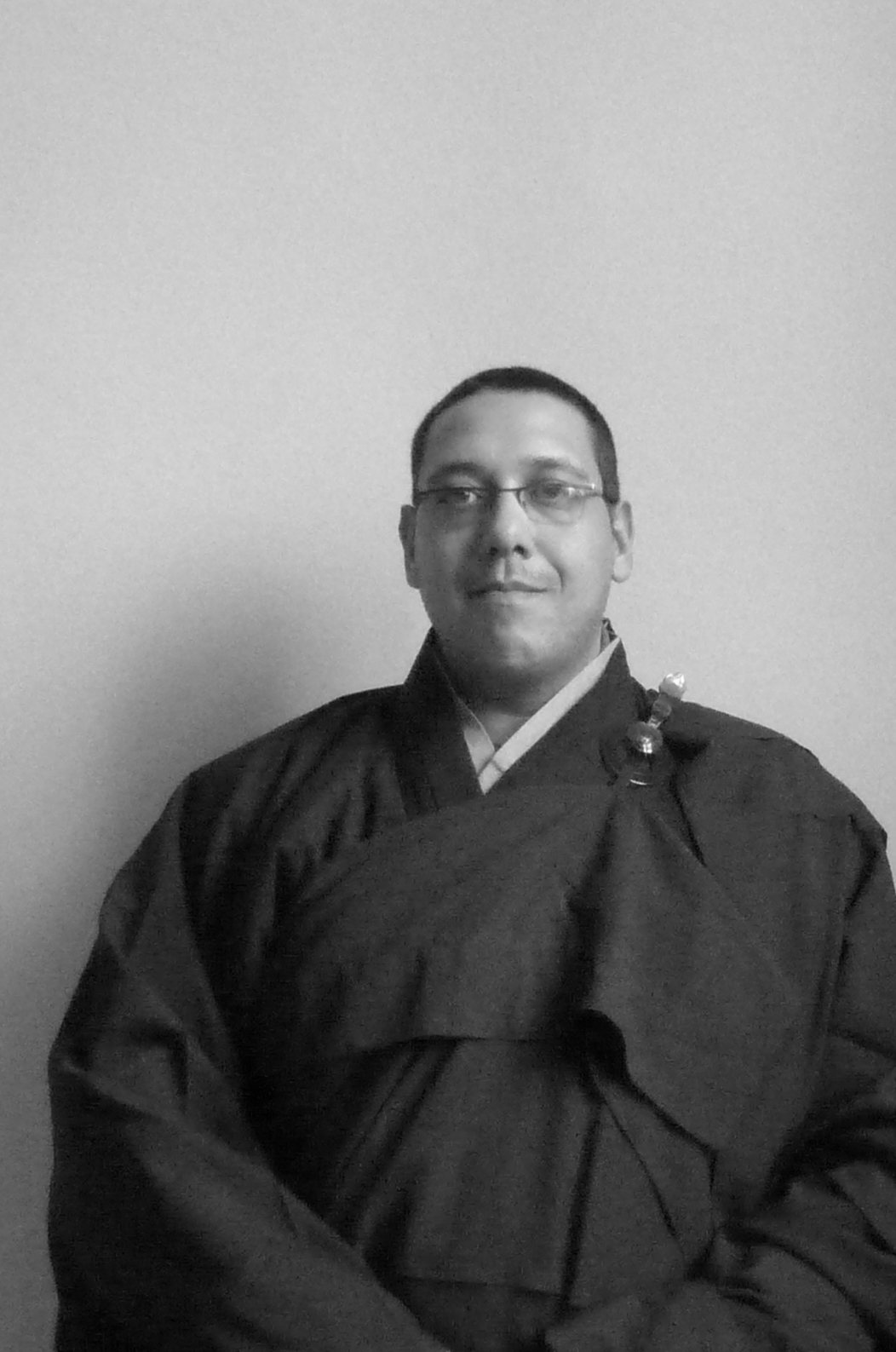
By: David Xi-Ken Astor, Sensei
I have been thinking a lot recently about karma and how we can learn through our Buddhist practice if it is possible to drive our own karma, or at least, what are we going to do about it. There is no point in pretending that karma has now become problematic for Western contemporary Buddhism. If we are honest with ourselves, most of us are not sure how to understand it. This is something I have become aware of in my own teaching and through group discussions. Karma has always been an essential element of the core Buddhist principle of mutual-causality, but we may not know how literally it should be understood using today’s language . Karma is often taken as an impersonal “moral law” of the universe, with a precise calculus of cause and effect comparable I suppose to Newton’s laws of physics. This understanding, however, can lead to a server case of “cognitive dissonance” for modern Buddhists, since the physical causality that modern science has discovered about the world seems to allow for no such mechanism.
Then again, some important Buddhist teachings make more sense to us today than they did to people living at the time of the Buddha. What Buddhism has to say about “no-self”, for example, is consistent with what modern psychology has discovered about how the ego and self-nature is constructed. In some aspects Buddhism can fit quite nicely into contemporary ways of understanding. But not traditional views of karma. Of course, this by itself does not disprove anything. It does, however, encourage us to think more deeply about karma.
There are at least two other problems with the ways that karma has traditionally been understood. One of them is its unfortunate implications for many Eastern-centric traditional Buddhist cultures, where a split has developed between how the Sangha is defined. In most of the East, and in many Western Centers as well, the Sangha is considered divided between the monastic community and the laity. Although the Pali Canon makes it quite clear that laypeople too can achieve an awakening, the main spiritual responsibility of lay Buddhists as popularly understood in the East, is not to follow a life of purposeful isolation behind walls themselves but to support the monastic’s that do, and by doing so gain merit. By accumulating merit they hope to attain a favorable rebirth, which for some offers the opportunity to become monks next time around. From my way of thinking, this approach makes Buddhism into a form of spiritual materialism, because Buddhist teachings are being used to gain material rewards. The result is that many Sangha’s and their supporters are locked into a co-dependent relationship where it is difficult for either partner to change. Continue reading










 Order of Engaged Buddhists
Pope Francis and the Dao De Jing
By: David Xi-Ken Astor, Sensei
Over the past few months we have been experiencing the social reaction to the election of the 266th Christian Catholic Pope. Like many former Catholics, I have been drawn by curiosity to see what this change may be all about. If what the early days of his pontificate may teach us, it will be quite a change. Pope Francis is bringing an old message back into the light of day, one that seems to have been muddled over the recent decades in our technological and capitalistic driven age. This old message was also one that was echoed 2,500 years ago by Siddhartha, the Buddha. Pope Francis is wasting no time in issuing an appeal that in the limited time he has in Rome we must return to the basics of social justice as it is reflected in responsible economic policies, having compassion for the less fortunate in our communities, in the focus of doing good, and in protecting the world environment. He said, “We must not be afraid of goodness or even tenderness.” A statement that is universal to a spiritual path. He went on to say that, “Let us never forget the authentic power is service. Only those who serve with love are able to protect.”
As I think about his message I am reminded of the expansive thoughtfulness found in Chapter 60 of the Dao De Jing that speaks to this encompassing ideal. When I say encompassing, I mean universal. So lets look at this Chapter, and my commentary on it, to experience the lessons that point directly to the responsibility of social governance.
“Bringing proper order to a great state is like cooking a small fish.
When way-making (dao) is used in overseeing the world,
The ghosts of the departed will not have spiritual potency.
In fact, it is not that the ghosts will not have spiritual potency,
But rather that they will not use this potency to harm people.
Not only will the ghosts not use their potency to harm people
But the sages will not harm people either.
It is because the ghosts and sages do not harm
That their power (de) combine to promote order in the world.”
COMMENTARY:
First remember the historical context and language of this text. It is Chinese and developed over the period 403-221 BCE, which was also during the time of Alexander the Great. This period of Buddhist expansion in China paid homage to how ancestors influenced world order in many ways. Like in the time when Siddhartha lived it was believed that the realm of ghosts existed. In our 21st century reality some creative re-description is called for in bringing this chapter into contemporary understanding, but in doing so takes nothing away from it’s core message. Continue reading →
Leave a comment
Filed under Uncategorized
Tagged as Buddhist thought, commentary on the Dao, Dao De Jing chapter 60, David Xi-Ken Astor, Pope Francis