Category Archives: Uncategorized

Pope Francis and the Dao De Jing

By: David Xi-Ken Astor, Sensei

Over the past few months we have been experiencing the social reaction to the election of the 266th Christian Catholic Pope.  Like many former Catholics, I have been drawn by curiosity to see what this change may be all about.  If what the early days of his pontificate may teach us, it will be quite a change.  Pope Francis is bringing an old message back into the light of day, one that seems to have been muddled over the recent decades in our technological and capitalistic driven age.   This old message was also one that was echoed 2,500 years ago by Siddhartha, the Buddha.  Pope Francis is wasting no time in issuing an appeal that in the limited time he has in Rome we must return to the basics of social justice as it is reflected in responsible economic policies, having compassion for the less fortunate in our communities, in the focus of doing good, and in protecting the world environment.   He said, “We must not be afraid of goodness or even tenderness.”  A statement that is universal to a spiritual path.  He went on to say that, “Let us never forget the authentic power is service.  Only those who serve with love are able to protect.”

As I think about his message I am reminded of the expansive thoughtfulness found in Chapter 60 of the Dao De Jing that speaks to this encompassing ideal.  When I say encompassing, I mean universal.  So lets look at this Chapter, and my commentary on it, to experience the lessons that point directly to the responsibility of social governance.

“Bringing proper order to a great state is like cooking a small fish.
When way-making (dao) is used in overseeing the world,
The ghosts of the departed will not have spiritual potency.
In fact, it is not that the ghosts will not have spiritual potency,
But rather that they will not use this potency to harm people.
Not only will the ghosts not use their potency to harm people
But the sages will not harm people either.
It is because the ghosts and sages do not harm
That their power (de) combine to promote order in the world.”

COMMENTARY:

First remember the historical context and language of this text.  It is Chinese and developed over the period 403-221 BCE, which was also during the time of Alexander the Great.  This period of Buddhist expansion in China paid homage to how ancestors influenced world order in many ways.  Like in the time when Siddhartha lived it was believed that the realm of ghosts existed.  In our 21st century reality some creative re-description is called for in bringing this chapter into contemporary understanding, but in doing so takes nothing away from it’s core message. Continue reading

Leave a comment

Filed under Uncategorized

The Zen Art of Teaching Birds To Fly

By: David Xi-Ken Astor, Sensei

In teaching Buddhism, and especially zazen, I am constantly reminded of Dogen’s statement that “To study the Buddha Way is to study the self.”  This is not only the essential ingredient in his Genjokoan, but also the driving force that moves us along our encounter with the Buddha’s primary teaching of the Four Noble Truths.

The Zen master, Shohaku Okumura Roshi, tells us that the word study that Dogen uses in Japanese is narua.  Okumura tells us, “Narau comes from nareru, which means: to get accustomed to, to become familiar with, to get used to, or to become intimate with.  This is not simply intellectual study.”  He continues to tell us that the Chinese character for narau is written in two parts.  The first character means “bird’s wings” and the second one means “self”.

This explanation took me back to an experience I had many, many, years ago when I had a large house that was divided into two apartments.  I lived upstairs, and I rented the downstairs.  One of my renters was a young single mother with two sons.  The older kid was about six and his name was Jimmy.   Like most boys his age he was always hanging around watching what I was doing; mowing, fixing a stuck door,  planting a tree, that sort of thing.  He was just very curious, and generally was not annoying.  I could not drive my car into the garage that he did not come running to see what I brought home.  One day as I drove up I noticed under the large tree in the back yard a commotion on the ground.  It was a bird that seemed hurt.  But after a moment I realized that what I was observing was a young bird and his mother higher up in the tree teaching him how to fly.   She would hop down, then fly back up and call down to him.  He would hope around and try to fly a few feet at a time.  This was repeated over and over.  As I was transfixed on this event Jimmy came running up.  I pointed out the bird on the ground and ask him what he thought was happening.  He said he thought it was hurt or sick.  When I pointed out that the bird on the ground was young and was being taught, through encouragement, how to fly by his mother up in the tree, he was truly dumfounded.  I remember this so well even now.  He looked up at me with those blue eyes and a look that was overwhelming and said “I thought birds could fly by themselves.”  He was transfixed as I too was on what was happening.  But what he said next was very memorable.  With a true look of wonder Jimmy said “I didn’t know that.”   Even for a six year old, this was a moment toward understanding and wisdom.  As a young person himself, there might have been a connection some how with the bird and his own growing experiences.  Kind of like narau.  In many ways, we too have to learn how to fly.  This is an essential meaning to how Dogen engaged zazen.

When we engage zazen practice, we engage this study-of-the-self admonition.  We study the self in order to awaken to how we are.  That awakening awareness is what drives the change necessary for our self-flourishing.  In other words, we must learn to fly too.  We awaken to this notion of the self being the only foundation that is none other then our Universal expression.  Like the baby bird that has the ability to fly and yet does not know how until it observes the skillful teaching of the mother,  our zazen practice is driven by the skillful teachings of others that have gone before us and the observation of this self we call ’I”.

As flying is an essential attribute for a bird to be a bird, so is the study of ourselves essential for discovering our human natures.  We awaken to what truly makes us human when we gain a quiet abiding body-mind that is the self of our Buddha natures.  Then we too will fly with the birds.

The Study Of Self:
“To study the Buddha Way is to study the self.  To study the self is to forget the self.  To forget the self is to be verified by all things.  To be verified by all things is to let the body and mind of self, and the body and mind of others, drop off.  There is a trace of realization that cannot be grasped.  We endlessly keep expressing the ungraspable trace of realization.”

— Dogen Zenji from Genjokoan

Leave a comment

Filed under Uncategorized

Multi-Dimensional Aspects Of The Four Noble Truths

By: David Xi-Ken Astor, Sensei

There is an interesting dimension to Buddhist teaching which is both inspiring and fascinating, but which is not always apparent to either the beginning student or even the more experienced ones.  That is, how often do we hear specific Buddhist lessons presented that often mysteriously reflect other aspects of Buddhist thought other than the one presented.  Specifically I am thinking about the Four Noble Truths.  I have awakened to how the whole Buddhist path is a macrocosm that can be expressed and understood through each element of teaching within it, starting with the Noble Truths.  Consider for a moment the lessons inherent in the Jewel Net Of Indra.  Where each jewel reflects all the other jewels in the net of co-dependence,  and that this net is a metaphor for the nature of our Universe.  This is somewhat a revelation for some when they come to realize how Buddhist lessons can be studied and are often capable of showing how our practice reflects the essence of the entire Buddhist dharma.  This is also an example of the transformation of ideas that reflect how we must encounter and understand the lessons from different traditions in order to give us a chance for a clearer meaning to our understanding of the dharma in our contemporary lives.  Even if we do not adapt them to our own platform and practice.  The Dalai Lama expressed it this way, “Buddhism is more than an Asian religion.  As the teachings of the Buddha (dharma) become better know and practiced in Western countries, it is vital to understand their place in Western history and culture.”

The challenge of this realization comes when we consider that each Buddhist tradition has developed over time their own interpretations, selected and adopted suttas, and external concepts and practices outside the Buddhist Cannon.  But at the same time these external concepts become a part of the Cannon within their tradition, and are reflected along with the standard teachings that are common to all the other traditions.  For example, some traditions are more comfortable relying on mystical and metaphysical interpretations and beliefs and finding ways to integrate them into their common teaching, than are other traditions.   Yet, the underlying message is basically the same.  The Buddhist practitioner must decide which tradition best reflects their own worldview and practices, and then commit to follow the path according.  But we must always work to find the lesson that reflects Universal reality, or Dharma.  We must also remember that this is a mutual-causal Universe and we must leave room open for change as our own experiences, and expert research by others, points to a clearer understanding of the Dharma as time evolves.

I would like to explore the Four Noble Truths in terms of how they can be understood through other aspects of  Buddhist teaching.  Although it is said there are eighty-four thousand discourses that the Buddha used to teach his disciples over forty years, all of them are an expansion of details on this core teaching.  I choose this as they are fundamental to all Buddhist traditions.  Let me call your attention to the Sammaditthi Sutta from the Majjhima Nikaya.  This Sutra #9 is by Venerable Sariputta on Right View and speaks at length on the teachings of the Four Noble Truths.

Continue reading

Leave a comment

Filed under Uncategorized

Can A Buddhist Ask “Does God Exist?”

By: David Xi-Ken Astor, Sensei

For some time now I have wanted to talk about the subject of whether or not God exist.  You can imagine that as a Buddhist teacher I get asked if I believe in a God frequently by those unfamiliar with Buddhist thought.  You see, our culture is confused about what Buddhists believe, and the role Siddhartha, the Buddha, expresses in the Buddhist faith.  The word “faith” goes along with the word “God” when the question is ask most of the time, that is why I am using it here. Considering this question, Buddhism generally takes a more pragmatic and agnostic approach, rather then get involved in theological dogma, preferring neither to say yes or no, and thus taking the Middle Way.  The Buddha himself did not deny or confirm the existence of a Creator God, but taught that there is no need to have an answer to this question because it did not achieve awareness of how we are that can lead to an enlightened state of body-mind.  Theism is not a central component of Siddhartha’s path to enlightenment, and the notion of a God was one of those questions he refused to speculate about because he was more intent on individuals seeking a way from their unsatisfactoriness through their own experiences, and thus to human flourishing.

But many of our Buddhist legacy teachers did speak about this question in either direct or indirect ways.  I will stick my neck out here and say that many of our enlightened Buddhist masters may have spoken about the “Does God Exist” question because they considered the answer to be in the question.  For myself, I believe the question is more complex than a simple yes or no answer, or even taking an agnostic worldview.  That is why I refer to myself as a reluctant agnostic.  I think the answer to this hard question requires a more nuanced consideration, as my spiritual practice works to seek an answer that expresses something more then a simple dismissal of what reality may be.  Much of my adult life has been seeking the quest for an answer to this question, and unsatisfactory answers was the major reason I left my Christian monastic practice.  Now that I am walking the Buddhist path, the quest is still a driving force in my recognition of how I am.  But my view of how the word “God” has transformed into a wider concept then just creation being a noun has dramatically changed how I approach the subject now, taking into consideration my understanding of the principles of mutual-causality, impermanence and the reality of a non-dual state of being.  When I am ask the question now, I generally ask, “What do you mean by God?”  This delays the obvious perhaps, but it gets the questioner a chance to think about their own way of expressing a question that has no absolute response.  I think an answer is incomprehensible if it is a good one anyway.

Continue reading

Leave a comment

Filed under Uncategorized

The Social-Self: Ethics Without A Creed

By: David Xi-Ken Astor, Sensei

When we speak about the Buddhist principle of non-self (anatman) we attempt to envision the notion of a self as expressing Universal realities without making the distinction that we are independent of all other Universal expressions.  Never an easy exercise.  One example of this would be that our human expression is only different from other animals simply by the complexity of our behavior — not just behavior, but our ability to reason.  Our ability to learn, gain knowledge that promotes wisdom, and thus act with reasoned intent, is what advanced human specie development.   In general, most individuals work to understand knowing something by penetrating what lies behind the appearance of things.  This approach is good enough most of the time perhaps, but considering how our mutual causal Universe expresses itself, we need to work hard to find the change that is presented in each moment’s situation in order to awaken to truthful-realities that consistently challenge the view we have of the world around us as having some kind of permanence.  Our quest for “truth” can never be fully realized when we ignore that change is always a factor in everything we encounter, so “truths” are only momentary, and a state of permanence is only an illusionary concept.

This brings to my mind several questions.  Is our knowledge of things sufficient to understand how they really are?  Is the language we use to describe how we are interconnected to things capable of fulfilling our needs as realistic as how they actually can?  Is our Buddhist practice, as manifest in our intentional actions, able to help us realize a better future for ourselves and others?   Is there such a thing as unconditional obligations in a Buddhist practice?   When considering ethics pragmatically, I have great doubt about the suggestion that anything is unconditional as the driving force of self-interest is a natural aspect of the human condition.  When we introduce the element of social relationships weighted against the distinction between routine and non-routine civil behavior as judged by cultural norms, we encounter possible inhibitors when we act from a feeling of what is natural to “us”,  but interpreted as unrealistic to others, even when we are both using the same set of ethical expectations.  These inhibitors come into play when our personal needs begin to clash with those of others.

Continue reading

2 Comments

Filed under Uncategorized

Spiritual Life Is A Life

By: David Xi-Ken Astor Sensei

The spiritual life is first and foremost a life in that it is apart of the sum of the phenomena we call “me”.  It is not something we “take out” and wear during periods of contemplation, meditation, or feeling like a Buddhist when we are in the mood.  Either we have it or not.  It is that simple.  A spiritual life is not something we can study.  It is however, like all other dimensions that makes us up, when it is not nourished it will die.  It can be like other interests we develop, spend time with, then move on to other things.  What makes finding a spiritual interest different is that it appears to be a natural progression when we turn our attention to the bigger picture of what life may be about.  Like seeking the wonder of our world, seeking the spirit seems to be connected to our human condition, not something handed to us “by the angels.”    We live as spiritual individuals when we live seeking answers to the big questions.  It is something man has been doing since he walked out of his cave and looked up at the night sky.  The difference between him and us, is that we now have a language to express our spiritual natures, but the experience is the same.

To keep our spiritually alive we must constantly work at it.  This is the reason we engage meditation and contemplative practices.  I am reminded of the experiences I have had on my sailboat at sea in the fog, peering into the gloom listening for sounds and hoping I stay on course in order to avoid being lost and reach the harbor.  The spiritual life is all about keeping awake.  We must not lose our sensitivity to what inspires us to sit in contemplation keeping alert for “signs” we can use to stay on course.  We must always be able to respond to the slightest warnings in order to avoid running our life on the rocks that can sink a spiritual life as well.

Meditation is one way in which the spiritual man keeps awake.  The reality of a contemplative life , however, is that it puts us at risk of becoming distracted and falling asleep.  Meditation is a strict discipline, and not so easy to do well, at least in the beginning.   It requires perseverance and hard work to avoid falling into the trap of compromise.  When our zazen and contemplative practice is compromised, it is a failure.  Even when we keep at it without much focus.   A contemplative practice is a body-mind practice, that is the orientation of our whole body, mind, and spirit.  When you enter into such a meditation practice it is not without a kind of inner upheaval.  By upheaval I don’t mean a kind of ciaos, but a braking away of a normal routine of thought.  We move away from ordinary mind into an extra-ordinary inner space.  We move away from all those distractions that preoccupy us in our work-a-day world.  We move beyond all that.  It is not something that is easy moving from an active mind to a passive one so we can experience the quiet necessary to transcend the ordinary.  The bridge is not easy to find either.  It may take years to find the bridge.  But once found, we know the way again.

Neither imagination or raw feelings are required for the transcending nature of the contemplative state of mind.  It is hard to put into human language, but there is a very real and recognizable sense when we tune into our inner space.  Our inner eye opens to the center of our spiritual natures.  Meditation and contemplation is the opening of this eye.

Leave a comment

Filed under Uncategorized

A Spiritual Life Is Not A Mental Life

By: David Xi-Ken Astor, Sensei

A spiritual life is not a mental life.  It is not thought alone that creates a contemplative state of mind.  It is not a life of sensation or felling of ecstasy.  Contemplation is not about stepping on the mystical carpet and flying away.

The contemplative aspects of a spiritual life, however, does not exclude thought and a deeper sense of awareness either.   But it is not just a life where the body-mind and imagination are excluded.  If that were the case, very few individuals would be able to have a successful contemplative practice without retreating into a cave for a decade or two.  Considering man’s social natures, that would not be a life enriched by an engaged social practice, but one totally turned inward toward the self excluding others.  Even though the intent of such a life might be honorable.  It would not be one most would associate with Mahayana Buddhism.    If we are to be truly alive, we must be committed to our practice body, mind, heart, and spirit, directing our compassion towards helping others.  For a monk, that is the heart of our Bodhisattva vows.

It is unproductive to try to achieve a contemplative state of mind merely by stringing thoughts together and then “thinking” about them.  While thinking is the first step in our contemplative session, we must use those thoughts as a springboard into our inner world that reflects the state of our practice beyond words and thoughts.  The quality of such a practice depends on the depth we venture into as we activate our inner-vision.  A purely mental practice may destroy any chance we have to go beyond the ordinary.  In that case we substitute thought and ideas for the real thing; for real awakened moments.  Any activity associated with what makes us human is not purely mental as we are not just a disembodied mind.  This is why validating our experiences is so important to our contemplative practice because it keeps us balanced.

What we achieve from a contemplative practice must also be brought back into our everyday lives in order to move our knowledge to wisdom that gets us ready for more awakened moments.  As we make it apart of ourselves, we enter into the reality that is signified by our concepts.  This is the cycle-of-life of a contemplative.

Thomas Merton in his work, Thoughts In Solitude, said, “Living is the constant adjustment of thoughts to life and life to thought in such a way that we are always growing, always experiencing new things in the old and old things in the new.  Thus life is always new.”    It is yet another illusion when we think that our contemplative mind state is separate from how we live our lives as though it is separate and two different concrete realities.  When we sit in contemplation we are not sitting in a dream state.  We must keep an alert mind not distracted by our personal filters that dilutes how we see the world, AND the Universe around us.  This is why zazen is so important.  In mindful meditation we are preparing the mind for the contemplative.  A quiet mind, is a ripe mind.  That is the platform upon which our contemplative practice stands.

Leave a comment

Filed under Uncategorized

Considerations on the Monastic Vocation

By: David Xi-Ken Astor Sensei

“To be a person implies responsibility and freedom, and both these imply a certain interior solitude, a sense of personal integrity, a sense of one’s own reality and of one’s ability to give himself to society…”

Thomas Merton from Thoughts In Solitude

Living a traditional monastic life could be viewed as being very scandalous in that a monk, Buddhist or Christian for that matter, seems to have no specific task that could be considered a job in the secular sense of the word.  That can be a mistake if you think monks are free from work tasks in order to spend all their time in meditation and scholastic activities.  In reality though, the life in a monastic community has many tasks and organized routines so their world is very much similar to the social life like everyone else’s.  This is especially true when the monastic community is living outside the walls of the monastery.  This kind of social life can become complicated and overly active in a way.  Living as a monk does not shield you from all the life challenges of an ordinary life.  In reality it is filled with all the ordinary life tasks plus enhanced practice ones too.  A growing number of monks now work outside their houses in order to share in the support of their community.  The monk is not defined by his tasks, job or secondary profession, but by his commitment to his practice as shared with his dharma brothers under the guidance of his sensei.  In a certain sense the monk is supposed to live an unstructured life because his mission is to be ready to engaged the dharma in whatever form it is presented in the moment, with little family or social distractions.  This means that monasticism aims at the cultivation of a certain quality of life, a deeper level of awareness, an awakened consciousness which is not usually possible in an active secular world these days.  In this 21st century we have so many distractions to keep us from our practice.

I do not mean to imply that the secular lifestyle is somehow totally about self centered priorities, or that there can be no real understanding of the importance of developing an interior awareness.  But it does mean that more immersion and absorption in worldly business will take away from a contemplative mind state that is of utmost importance in gaining readiness for experiencing awakened moments.  There is much to be said about a sustained practice over one that experiences fits and starts.  Monks are not weekend warriors, but seek to be free from what William Faulkner called “The same frantic steeplechase toward nothing” which can be the essence of a Buddhist practice when engaged for a few hours a month.

As a monastic community lives together, either in groups or alone but connected, they do so with a sense that they are not separate from the lay community they live side by side with.  We should avoid any notion of “inside or outside.”  The concept of “separation from the world” that can arise in a monastic community is yet another illusion.  Even for those monks within the walls of a monastery/temple.  We must never forget we are social-selves and agents for change.  We do not take vows to become a different species of being.

Continue reading

Leave a comment

Filed under Uncategorized

Creating A Sacred Space & Buddhist Altar

By: David Xi-Ken Astor, Sensei

This guide is meant to assist in creating a home sacred space with an altar for your Buddhist practice.  These suggestions have been used by both OEB in our Chapter Houses as well by our lay organization, EDIG, for home use.  It is intended for the Ch’an/Zen practitioner, as the various Buddhist schools have different practice intentions that are reflected in how the various elements of a space and altar are utilized.   As contemporary Zen monks that work to find pragmatic lessons in all we do in life, we feel that how we approach our intentional ritual practice should be no exception.   It is not what we do, but how our body-mind is during practice that matters.  The suggestions here have been adopted by us that follows the tradition of David Sensei’s monastic roots.

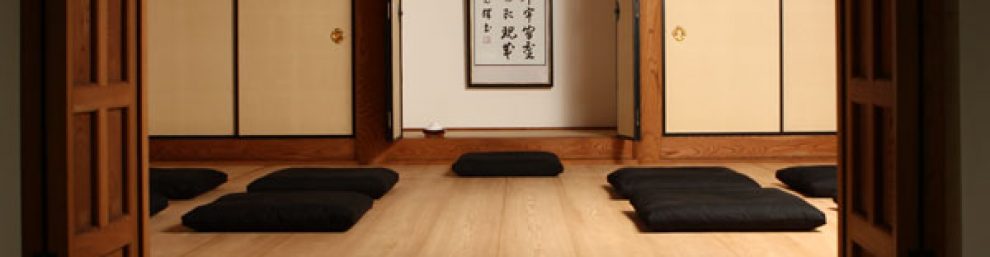
An alter is one element of creating a sacred space where we retreat to quite the mind and sit in awareness.  The environment associated with this special space is what matters, not what is in it.  However, having meditation cushions, items that act to remind us of the importance of what we have dedicated ourselves to practice, and a consistent location is of importance.  How we go about fulfilling these requirements will be different for each of us, depending on the various demands our private lives require.  There will be as many options and materials to use as there are creative ideas.  There are very few rules to follow.

The sacred space you create can be used for both zazen (mindful meditation) or contemplation.  But it is highly recommended that a separate element be added to your space for contemplative practice that is different from where you sit for meditation.  This is done so the bodymind is clear as to what practice you are about to engage.  Meditation cushions are generally used for meditation, and a chair is used for contemplation.  Always do meditation first before contemplation so your mind in meditation is quiet and not in the thinking-mode as a result of your contemplation period.  Most individual finds it helpful to do the two practices at separate times of day/night.

So, enjoy the project and send us pictures of what you have accomplished.  While one of our monks will not be able to visit your space in order to bless it, if you ask us to, we will do so with intentional mindfulness during one of our daily monastic services.

The Space:

Choose a location that is away from the more active areas of your home.  This is often a bedroom.  However, if you use a bedroom that is shared with a loved one, make sure you talk this over with them in order to obtain a consensus.  It is quite OK if the space is shared with others.  The area should be able to be shut off from the other spaces in the home during meditation/practice periods, if possible.  A space with limited or low light, and that is well ventilated, is preferable.   The idea here is to limit distractions, and create a space that is comfortable and inviting.

As mentioned, it is not necessary that the space be permanently set-up.  You might keep your supplies in a container and the cushions stored in a closet or under a bed, for example.  You can also acquire a wall altar that has doors that shut when not in use.  This is an excellent alternative for small spaces.  Many altars have been set-up on a bookshelf, and the meditation cushions brought out during practice time.   So be creative.  But the one basic requirement is that the space be consistent.   As we train the mind to be quite, having a familiar space helps.

The Altar:

A home altar is difficult to define.  It acts as a focal point of our practice space.  It is an anchor, and in many ways, represents our intentions.  As such, it can be very personal, and what we bring to it gives special meaning as we practice with it.  There are very few necessary elements that may be considered necessary; everything else are personal touches.

We recommend that your altar consist minimally of three tea candles to represent the Three Jewels, an incense burner, and a representation of an Universal expression.  The Universal expression is where your creative imagination comes into play.   Most often it is a statue of Buddha.  But that element is not necessary.   Other iconographic images can replace the image of Buddha.  They can be an eight-spoke Dharma Wheel, an image of the mudra hand, a specific image of a column, a thrown, flowers – especially the lotus, and something like a fan with the Heart Sutra printed on it.   Perhaps a nice scroll or print on the wall behind your altar is something that you already have that you enjoy.  Some altars have a ‘minimalist’ look with the candles, an incense bowl and a few flowers.   Unlike the Tibetan or Pure Land Buddhist schools, it is not necessary to face your altar in a specific direction or level of the house.  A basement space is fine, and often preferred.  Don’t think your altar must be like what you see in temples and practice centers.  A home altar should reflect your own needs for achieving a body-mind state of peace and contentment.

The layout of the altar can vary, but the one we use that is more common to Ch’an Buddhism and adopted by the Order of Engaged Buddhists as well as our lay organization, EDIG, is: the Universal expression such as a Buddha should be placed in the middle.  The three tea candles are placed one to the left and right sides, and one in the center of this image.  The incense burner is placed behind the central image.  If you don’t have space behind the Buddha image, place it in front but behind the central tea light.  Other items can be placed on the altar but in a way that does not disrupt this basic layout.  For example, I keep a picture of my three teachers to the far left, with a red votive candle in front of my late teachers picture.

Place your altar along a wall or in the center of a room.  Put your meditation cushions in front of it about five feet back giving you room to light the candles and perform the incense offering ritual.  If you have a cheng bell, it should be placed to the right of the cushion, and a fish-drum to the left.  This is not necessary at all.  But as your practice matures, you will want to add these to your practice space in order to do bell meditation.

Have fun putting your altar together, but be thoughtful.  Maybe your altar is going to be a “work in progress” until you find the right elements that express your personal practice intentions.  Use the pictures below for some ideas.

alter12alters1

alter10

alter3

alter11

If you are interested in obtaining a copy of the Order’s Daily Monastic Service, please send us a request with your name and address and we will make sure you receive one.  The bound service book is $8.00. 


1 Comment

Filed under Uncategorized

Our Yearning To Find Meaning In A New Year

By: Ven. David Xi-Ken Shi

Human beings seem unique in their yearning to find meaning.  Dr. Nuland calls it “seeking the spirit and wonder” of this world.  In the morning I open my eyes, look in the mirror, and see someone I call myself.   I look around and observe space and place and I call that my world.  I interact with others and call those my relationships.  And into all of this, I attribute meaning: what does this thought, emotion, situation or event mean?  How do I interpret that meaning to obtain what I want or think I need right now.  Our Buddhist training challenges us to ask the deeper question, the real question: who is this person, what is the  reality of this world the best I can become awakened to it, and how do I live my life without creating suffering?

Sometimes when I see a small child I think how wonderful it would be again to not have to worry about putting a roof over my head, or how to feed myself, or will I continue to have good health, or is this neighborhood safe, what is a mortgage, how much is bathroom tissue, or do others like me?  That was a time of innocence, of protection, and of being close to a warm and safe source, without the stress over the cost of living a life in the real world.  But no longer being a child, we can’t go back.  Those days are over.  The fact is, we can never return to anything, ever.  One moment arises, never to be seen again.

To give up all seeking of past or future, and die to the very self that seeks to return to a more innocent time, is the great challenge of a Buddhist practice.  For Buddhists, we can’t be on the path unless we actively seek the dharma, and yet in that very seeking, inevitably we turn away from the our self as we have come to realize it.

It is not possible to return to a previous state of being, the mutual-causal Universe doesn’t work that way.  Even now when we return home to our parents, we are no longer treated as a child, hopefully anyway.  And this is quite natural.  The parent not paying attention to us like they use to has nothing to do with disregard.  It has nothing do to with not loving us or lack of interest.   It is just that our interaction with them is now in a different moment, with a different set of realities.  Our parents have moved on too.  From a Zen teaching perspective, an old Zen master might say, “At this point the empty sky’s vanished and the iron mountain has crumbled, there is not an inch of ground to stand on.”  In other words, it is a different state of knowing.  The forms of each puzzle piece has been changed, and there relationship to each other take on a different meaning, while the image of the puzzle retains its original nature.   The ground we use to sand on has vanished, NOW is only how we are in this very moment, and it IS our home.

Each of us have had moments in the past where we have visited a new place, taken on a new activity, or met someone for the first time, and we have experienced that it felt very familiar, even like home, or we have know the person for a long time.  What is interesting about these experiences is that we are immediately aware of them.  What were we really experiencing?  What kind of reality were we experiencing that gave rise to that deep sense like we have when we are at home?  What is home?  It’s that place where we feel a special relationship with place, as well as those connected to it, including ourselves.  It is a place we feel loved.

Continue reading

Leave a comment

Filed under Uncategorized